Category Archives: Travel

Travel and world news

Deadvlei

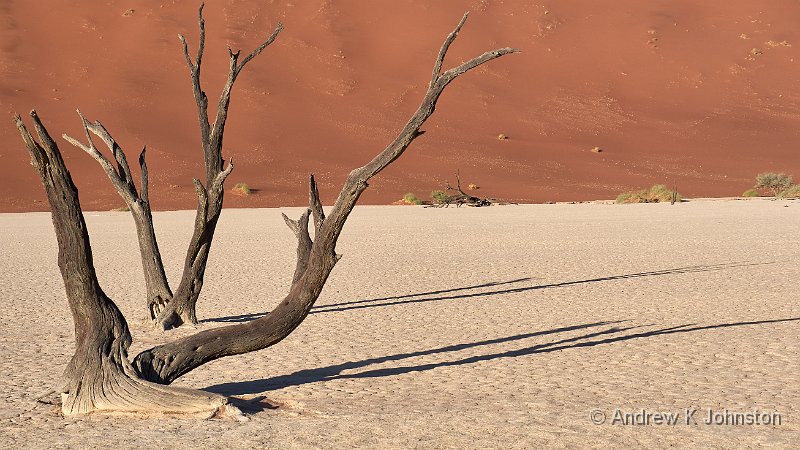
Tree at Deadvlei
Camera: Panasonic DC-G9 | Date: 21-11-2018 07:06 | Resolution: 5224 x 2939 | ISO: 200 | Exp. bias: 0 EV | Exp. Time: 1/400s | Aperture: 6.3 | Focal Length: 38.0mm | Lens: LUMIX G VARIO 35-100/F2.8

Deadvlei is the home of the iconic Namibian desert image: a dead tree on a salt plain with an orange dune in the background. Despite the ubiquity of such images, in practice it’s a single relatively small location, a bowl in the dunes maybe 500m x 200m. Hundreds of years ago it was a small oasis with fairly healthy vegetation, but the shifting dunes cut off its water supply, and the trees died. However in the dry, sterile conditions they have only decomposed very slowly, and are effectively now petrified. The other thing which is surprising is the salt pan – I was expecting a fairly thin even crust like you see in pictures of Bonneville, but instead it’s a rocky, lumpy and very solid arrangement.

Our tour bus took us the 70km down the Sossusvlei valley to the end of the surfaced road, and we then took a 4×4 shuttle 4km through the sands to the jumping off point for several walks. It’s about 1.1km to Deadvlei, a distance which I would normally knock off in about 12 minutes, but walking on the sand proves very difficult, and it took me over half an hour. My combination of small feet and, er, large frame means I just sink into the sand with every step, and it’s suspiciously like wading through treacle.

Regardless, our timing was good and the walk fully justified by the scene. We had timed our arrival to be there just as the sun was reaching into the bowl, and we got great shots of both trees just emerging from the shadows, and in full light against the orange dunes and cloudless blue sky.

We were just packing up to go back when we got the first hint of what was coming, some lines of sand being whipped across the salt, which stung the legs as they hit them. We had a brief respite as we walked back, but by the time we arrived at the car park we were in the middle of a full-blown dust storm, so bad at times other vehicles were invisible except for their lights. We had a 4km drive in an open 4×4 through this, which was not pleasant. I’m not sure that it was ever actually on my list, but "sandstorm" can now be ticked off.

We had a relaxing middle of the day, but I was starting to feel a bit weary and couldn’t face the walk into Deadvlei twice in one day, so at the end of the day while the rest of the group went back to Deadvlei John and I commandeered the 4×4 and went photographing dunes off the sand road. We got some decent shots, but it’s a challenge as the salty ground and scrub vegetation make getting a neat foreground a real challenge. I made a few "rookie errors", including shots out of focus and then trapping my finger in the car door, and decided that I really need to not do three 4.15 starts in a row. Tomorrow I’m going to boycott the dawn start and have a lie in…

View featured image in Album
Posted in Namibia Travel Blog, Travel | Leave a comment

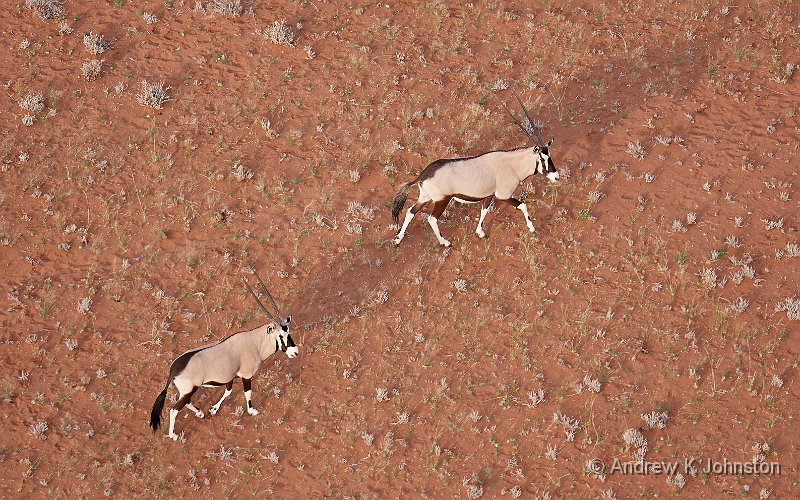
Oryx from the air

Oryx from the air
Camera: Panasonic DC-G9 | Date: 20-11-2018 07:06 | Resolution: 3174 x 1984 | ISO: 200 | Exp. bias: 0 EV | Exp. Time: 1/1000s | Aperture: 3.2 | Focal Length: 100.0mm | Lens: LUMIX G VARIO 35-100/F2.8

‘Nuff said.

View featured image in Album
Posted in Namibia Travel Blog, Travel | Leave a comment

Nice Chopper (Ride)

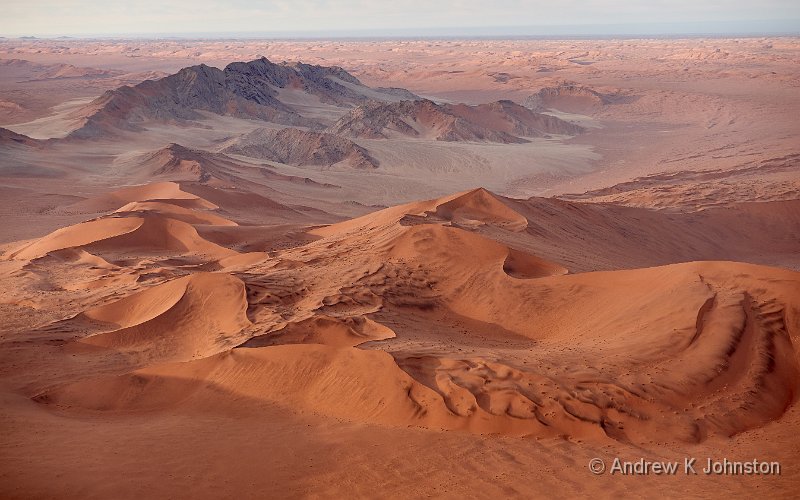
Namibian dunes from the air
Camera: Panasonic DC-G9 | Date: 20-11-2018 06:45 | Resolution: 5391 x 3370 | ISO: 200 | Exp. bias: 0 EV | Exp. Time: 1/500s | Aperture: 4.5 | Focal Length: 35.0mm | Lens: LUMIX G VARIO 35-100/F2.8

Up at 4.14, but in a very worth cause, our helicopter flight over the Namibian dunes. We had to take it in turns, as the company only have one helicopter with three passenger seats flying at this time of year, so I volunteered to go first along with Alison and John. We were met at the park gates by the pilot, a big South African called Pierre. After the usual necessity of signing one’s life away, he drove us out to the chopper, which turned out to be dramatically smaller than the last one I flew in, many years ago in Barbados.

Called a Raven II, this is a great sight-seeing device, with a clear bubble canopy, plus in honour of the photographic trip they had removed the doors, giving us each a wide view to the side, plus I could also shoot through the canopy to the front. It was fitted with harnesses very similar to standard car seat belts, but at least Frances’ fear that I would be left with two odd ends like Sam Neill in Jurassic Park was unfounded.

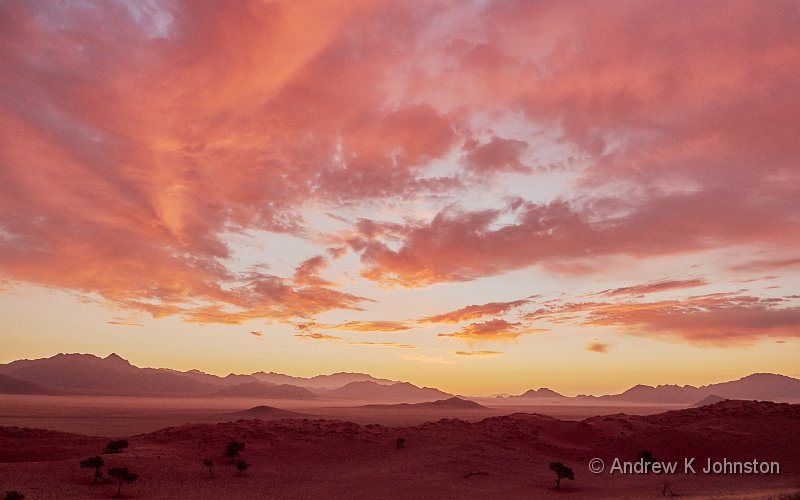
I have to confess that the first minute or so of the flight was a bit disconcerting, in that such a small craft has to tilt down quite sharply to build up speed, when you are still fairly low to the ground. However things quickly stabilised and we were humming along down the Sossusvlei Valley. We were initially battling poor light, but our luck held and the sun came out exactly when required, when we were turning over Deadvlei and Sossusvlei. However the slow appearance of the sun meant I got some very rare shots of the hills behind the dunes wreathed in cloud and mist – Pierre reckons he only sees anything other than straight sunshine about 8 days a year.

We then flew deeper into the dunes, and back to the airfield via some meadows with oryx, ostriches and jackals. These were trickier to photograph, but I did get one great shot of the oryx.

We were back at the hotel by 8am, just in time for breakfast, and had a great lazy morning before the rest of the group arrived back.

For the afternoon shoot we were meant to all go back to Deadvlei, but there was a problem with the booking for the 4×4 required to take us through the last 4km of sand track from the bus stop, and we had to re-plan. We spent the rest of the afternoon shooting dunes and trees along the road back to the hotel.

Another early start tomorrow – our turn to go to Deadvlei.

Addendum – Size Matters

If you’re going to do a “doors off” helicopter flight then the physical size of your equipment matters (ooh er missus 🙂 ). Smaller is definitely better. I got great results with my Panasonic G9 and the 35-100mm lens (70-200mm equivalent). Another group member shooting with the equivalent Olympus kit was also fine. However those shooting with the big Canons and Nikons and 70-200 or 70-300 lenses were finding great difficulty getting sharp images. The dual stabilisation of the Micro Four Thirds cameras helps, but the biggest contributor seems to be the fact that the big lenses project out of the cockpit into the slipstream, and the wind-shear on them makes them very difficult to hold still.

I also had the Panasonic GX8 with the 12-35mm lens for wider shots, and I was able to have both on the floor in front of me and switch between them. That arrangement also worked well, but would be tricky with physically larger cameras.

View featured image in Album
Posted in Namibia Travel Blog, Travel | Leave a comment

We’re On The Road To Nowhere

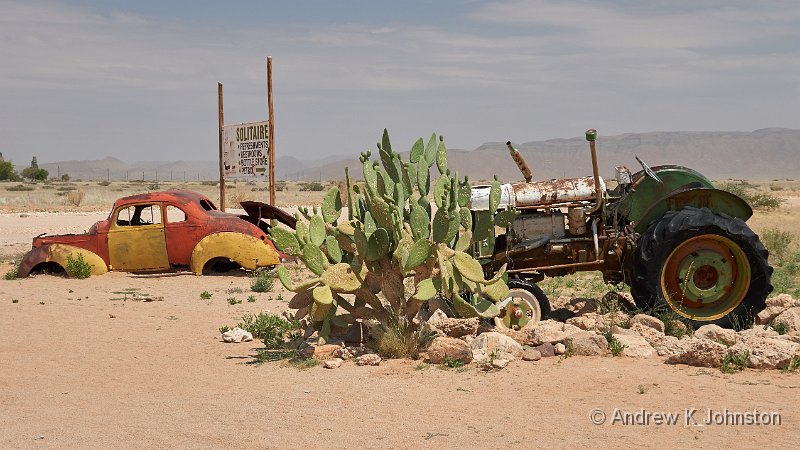
Old vehicles at Solitaire, Namibia
Camera: Panasonic DC-G9 | Date: 19-11-2018 14:40 | Resolution: 5098 x 2867 | ISO: 200 | Exp. bias: 0 EV | Exp. Time: 1/400s | Aperture: 8.0 | Focal Length: 28.0mm | Lens: LUMIX G VARIO 12-35/F2.8

Playlist for today:

  • On The Road Again : Canned Heat
  • Highway Star : Deep Purple
  • Bright Side of the Road : Van Morrison
  • Call Me The Breeze (I keep blowin’ down the road) : Lynyrd Skynyrd
  • Goin’ Down The Road (A Scottish Reggae Song) : Roy Wood
  • King of the Road : Roger Miller
  • Rockin’ Down The Highway : Doobie Brothers
  • Roll On Down The Highway : Bachman Turner Overdrive
  • Rollin’ and Tumblin’ : Canned Heat
  • Davy’s On The Road Again : Manfred Mann’s Earth Band
  • The Long and Winding Road : The Beatles
  • Crossroads : Eric Clapton / Cream
  • Rollin’ On : Uriah Heep
  • Road to Nowhere : Talking Heads
  • Road to Hell : Chris Rea
  • Highway to HellI : AC/DC

Did I mention it was going to be a long drive?

The south western quadrant of Namibia, an area comparable with Northern England, consists of the Namib Desert, and apart from a narrow corridor about 2/3 of the way down, plus a short stretch of coast, is all in one of two national parks. These are not crossed by road, and the few tracks into them are strictly controlled. The problem is that we start the day just north of the north western corner, and we need to get about halfway down the eastern edge. Therefore we have to circumnavigate the park on a Namibian "C" road. These are mainly unsurfaced, but wide and well graded. However speeds are inevitably slower than on tarmac, and there are periods where the ride is very rough, or it gets very dusty, or both.

We left civilisation at Walvis Bay, just south of Swapokmund, and the next habitation and services are over 200km away, at Solitaire, which appears to exist to service weary travellers at a key road junction. They do so in style, with a great collection of photogenic wrecked old cars, and their special, an excellent apple pie.

Another hour or so of driving brings us to Sesriem, gateway to the Sossusvlei area, and our base for the next few days. More than one night in one place? Luxury.

The Sossusvlei Dune Lodge is inside the park, which is good news for our forthcoming dawn starts. It’s run on a surprisingly Germanic basis, with more rules and constraints than we’ve experienced elsewhere. Quite a few of the rules seem to relate to keeping pests out of the rooms: mosquitoes (fair enough, although it is the middle of the desert), and baboons (I wasn’t expecting that).

Another early night: up just after 4 for the helicopter flight!

Addendum: 4am

Well, that blokes’ baboon repellent seems to have worked. The mosquito net also proved an effective barrier, locking a single mosquito in bed with me all night. Bugger.

Sleep was OK for quality…

View featured image in Album
Posted in Namibia Travel Blog, Travel | Leave a comment

Hot Dry Desert, Cold Damp Desert

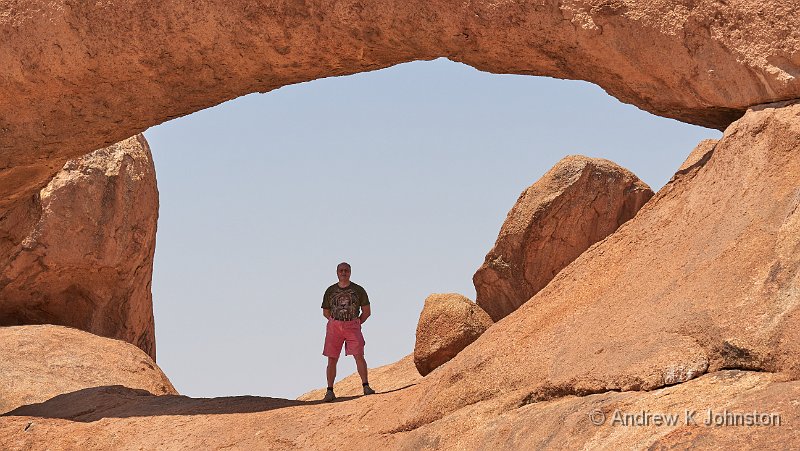
Yous truly under the rock arch in Spitzkoppe Park
Camera: Panasonic DC-G9 | Date: 18-11-2018 11:05 | Resolution: 5184 x 2920 | ISO: 200 | Exp. bias: 0.33 EV | Exp. Time: 1/800s | Aperture: 5.6 | Focal Length: 64.0mm | Lens: LUMIX G VARIO 35-100/F2.8

Despite the distractions of the chalet’s canvas roof I eventually got an OK night’s sleep, and woke up ready for action. With the sun just rising we had a great pre-breakfast shoot at Spitzkoppe, with the rock formations beautifully lit by low sun, and just a few whispy white clouds breaking a clear blue sky.

The Spitzkoppe Lodge is quite new. The unresolved issues with the roofs are one challenge, breakfast turns out to be another. Lukewarm coffee is a recognisable drink. Lukewarm tea is a waste of ingredients and a challenge to the nausea response.

After breakfast we drove to the other side of the park and made a short climb up to a rock arch. I scrambled up to the arch itself and had my picture captured, just in time before the group of about 15 Germans arrived via a much gentler path from the other side…

We then headed for the coast, along an absolutely straight, flat and empty road. At the start we were at about 1000m, in baking sun with the sand punctuated by occasional clumps of scrubby grass. At the end we were at sea level, under a grey sky, much cooler, with the sand punctuated by occasional small mossy mounds.

Lunch was taken at our driver’s favourite cafe in Hentis Bay, which appears to be a sort of African Clacton-on-Sea. The cafe is also recognised by another member of the group and clearly a known target. The food is tasty and the portions more than generous: I have something called a terrazini, a large flatbread stuffed with chicken, bacon and cheese and then toasted. Nigel goes for a burger, which turns out to be about the size of a discus.

After lunch we spend an interesting but surprisingly cold half hour photographing a shipwreck using very long exposures. It’s very good practice for me to remember how to drive a camera in manual mode, something I rarely do.

It’s a short drive down the coast to Swapokmund, a rather larger city, somewhat reminiscent of a European seaside town. This looks prosperous, but somewhat dead on a cold Sunday evening.

You can tell when a Namibian town developed by the signage and street names: somewhere which has developed since independence will be almost entirely English. Those which developed in the mid 20th century will use English and quite a lot of Afrikaans. Swapokmund obviously dates back to the 19th century and there’s a lot of German – our hotel is just off Kaiser Willhelm Strasse.

Early night. Long drive tomorrow.

View featured image in Album
Posted in Namibia Travel Blog, Travel | Leave a comment

Thrills and Disappointments

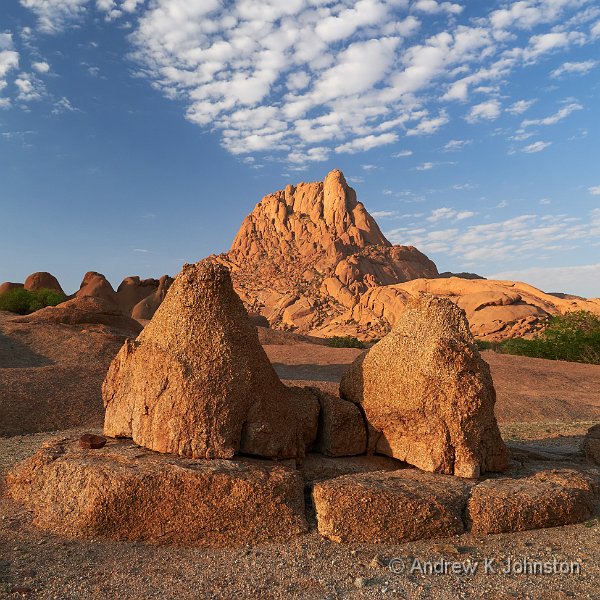
Granite formations, Spitzkoppe
Camera: Panasonic DC-G9 | Date: 18-11-2018 07:10 | Resolution: 3888 x 3888 | ISO: 200 | Exp. bias: -33/100 EV | Exp. Time: 1/400s | Aperture: 5.6 | Focal Length: 12.0mm | Lens: LUMIX G VARIO 12-35/F2.8

5am call, quick cup of coffee and back in the big FWD for "leopard tracking". This was a dawn game drive with a tracker for the radio collars fitted to the park’s other leopards. On the way we stopped to photograph more diverse ungulates (including wildebeest this time), baboons and some colourful birds.

We eventually tracked the other female down to a thicket about 100m in each direction, but she seemed to be moving. We drove back to the main track and I suddenly spotted a shadow moving at the thicket’s edge. We positioned ourselves in time for her to cross the track just ahead of us. Another gorgeous animal, and this time we were definitely not the prey.

It’s a six hour drive, including lunch, to Spitzkoppe. At least this allows me to variously catch up on sleep, writing this blog, and Angry Birds. Namibia’s roads are well surfaced, empty, straight and very boring.

Packed lunch from the game reserve included an oryx wrap. There’s a pattern emerging here…

Spitzkoppe is where a bunch of dramatic granite monoliths rise out of the otherwise flat desert, not unlike an African Monument Valley. We enjoyed the long drive in, promising ourselves some great late afternoon shooting, but by the time we got to the lodge and checked in the sun had disappeared behind clouds and the light was rather disappointing. Still, we can look forward to Dawn tomorrow.

Night 4 – Addendum

Ready for a good night’s sleep?

Sensible bed-time? Check. Sensible start time tomorrow negotiated, as worst case I can just photograph the sunrise from bed? Check. Right amount of food and alcohol, not too much, not too little? Check. Room temperature wrangled from "furnace" to "comfortable"? Check. Pillow adjusted to right height with towel? Check.

Ready for a good night’s sleep.

This is when I discover the major structural flaw in the design of the Spitzkoppe chalets. The base and sides are solid, but the roof is a weird double canvas affair. If it’s meant to manage temperature it doesn’t work. What it does do in any breath of wind over Beaufort Scale level 1 is whip, creak, groan, snap and pop vigorously. Something a bit stronger and it sounds like it’s about to come off. At midnight I decide the latter would be a good thing as then I could finish the night under a clear and silent Namibian sky. Sadly it doesn’t happen. At least that explains the earplugs in the soap dish.

The sleep deprivation experience continues.

View featured image in Album
Posted in Namibia Travel Blog, Travel | Leave a comment

A Long Drive, then a Great Opener

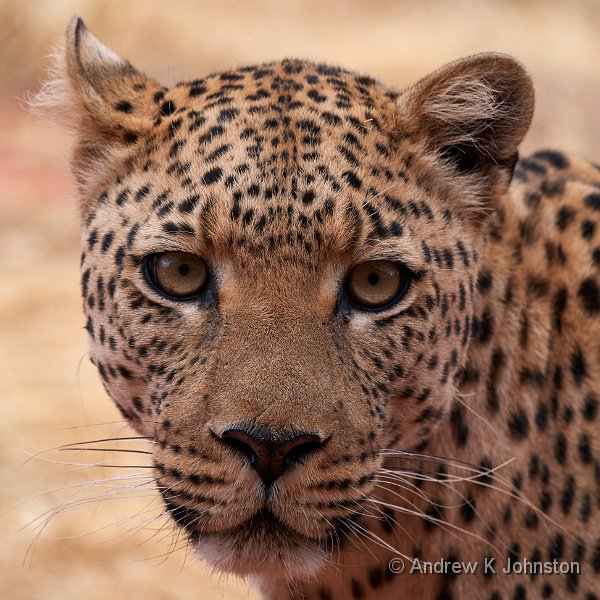
"Beautiful", the leopard
Camera: Panasonic DC-G9 | Date: 16-11-2018 17:44 | Resolution: 3888 x 3888 | ISO: 250 | Exp. bias: 0 EV | Exp. Time: 1/320s | Aperture: 5.6 | Focal Length: 150.0mm | Lens: LUMIX G VARIO 100-300/F4.0-5.6II

It’s looking like we will spend a lot of time on the road. Once our transport arrived on day 3 we drove back out to the airport to collect the final member of the group, then back past our hotel in Windhoek, then another 3+ hours north to the Okonjima Nature Reserve. There we transferred immediately to a 14 seat open-air FWD and set out on our "game drive".

This was absolutely excellent. Within shouting distance of the lodge we had seen warthogs, giraffes, oryx, springbok, kudu and various other ungulates whose names I can’t remember. Then we went into the cat enclosure.

First up were the cheetahs, which are apparently very used to humans and had also been recently fed, so were just lying around like large spotty moggies. They are smaller than I expected, but just as beautiful. It was great being able to photograph them at a range of 20m or less with no concerns on either side.

The leopard was a different matter. Okonjima have two adult females, both rescued from elsewhere, one of whom roams the main park with her two sons, but the other is kept separately as otherwise they would fight. The captive female has been trained to come to a hide from where she can be viewed at very close range. This is an unnerving process as she prowls up and down inspecting each visitor in turn, and would obviously love to get into the hide and choose from the menu if not prevented by an electric fence and mesh.

Maybe this was an encounter with a top predator who viewed us as potential prey. Maybe, but I have another theory. I think she has become a working animal with a reliable routine. All I could hear in my head was Joanna Lumley’s voice saying "sorry darling, I have to go. I have another group of tourists to scare."

Whichever is the case, she is aptly named with the local translation of "beautiful". Well deserved.

Dinner was oryx carpaccio, followed by oryx sirloin, and a chocolate mousse. "Chocolate oryx", surely?

View featured image in Album
Posted in Namibia Travel Blog, Travel | Leave a comment

Back On The Road

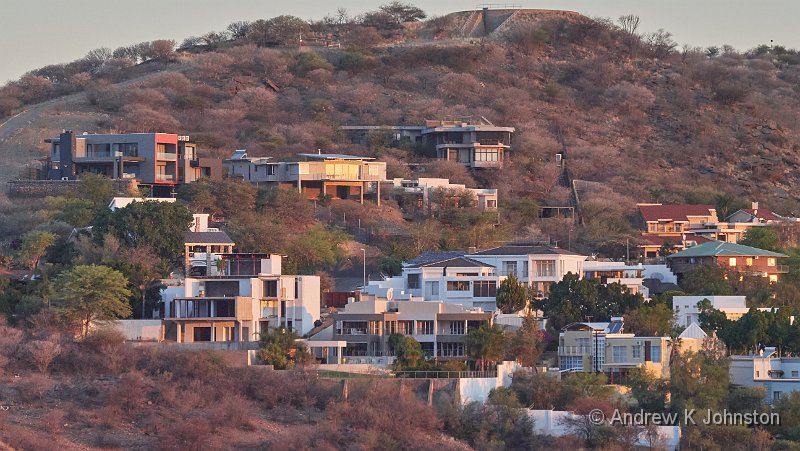
View of the Posh Bit of WindHoek from the Hotel Thule
Camera: Panasonic DC-G9 | Date: 15-11-2018 18:58 | Resolution: 5176 x 2915 | ISO: 3200 | Exp. bias: -66/100 EV | Exp. Time: 1/160s | Aperture: 8.0 | Focal Length: 100.0mm | Lens: LUMIX G VARIO 100-300/F4.0-5.6II

I’m off on my photographic travels again, this time to Namibia. I’m travelling with Lee Frost of Photo Adventures, as I did to Cuba and Morocco, and it promises to be an interesting mix of landscape, wildlife and general travel shooting.

As is often the case, the first two days were largely taken up with travel, although I learned my lesson from the Myanmar trip and made sure we built in some rest time as well. I can never sleep on a plane, and going straight out shooting after a long journey leaves me fit to be tied…

The main flight from Heathrow to Johannesburg was smooth, although delayed by a change of plane which significantly cut into the relatively short transfer time at the far end, and saw us almost sprinting through the terminal. However in marked contrast to recent experiences with BA, Virgin did an efficient job of boarding (by row number), and Johannesburg Airport staff did an excellent job of triaging their queues, so we got the connecting flight.

The long-haul flight was on a Boeing 787 "Dreamliner", which is a real curates egg, good in parts. The new technology like the electronically dimming windows works brilliantly, but some well established technology appears to have been sacrificed. I couldn’t on my own recline my seat, and the seat back pocket is now wholly inadequate. The tray table is a ridiculous design which slopes downwards and is made out of some shiny plastic – a young lady sitting near me got a glass of water in her lap halfway through dinner, and I’m aware she wasn’t the only one. On a single flight! How on earth did that ever get through QA? Why industrial design has to be this odd zero sum game is a complete mystery. If it ain’t broke…

Minor complaints aside the air transportation got us to Windhoek on time. It’s a surprisingly long drive from the airport to the city, I reckon at least 25 miles, and that’s another mystery, given that most of the intervening countryside is completely empty and flat as a pancake. I can only assume that the former owner of the airport land was on the "where should we put the airport" commission.

Windhoek, at least the bits visible from the main roads, is a spacious, modern city. For our first night we stayed at the Hotel Thule, which sits on a promontory overlooking the rest of the town. It’s a very pleasant place to stay and also seems to be one of the "in" places for the locals to eat. A gentle afternoon and late start next morning at least started my batteries recharging.

Dinner is an oryx steak, slightly overcooked but otherwise delicious.

So far it’s warm, but manageable during the day, but hot at night, not less than about 26°C.

View featured image in Album
Posted in Namibia Travel Blog, Travel | Leave a comment

The Hut of Alleged Towels

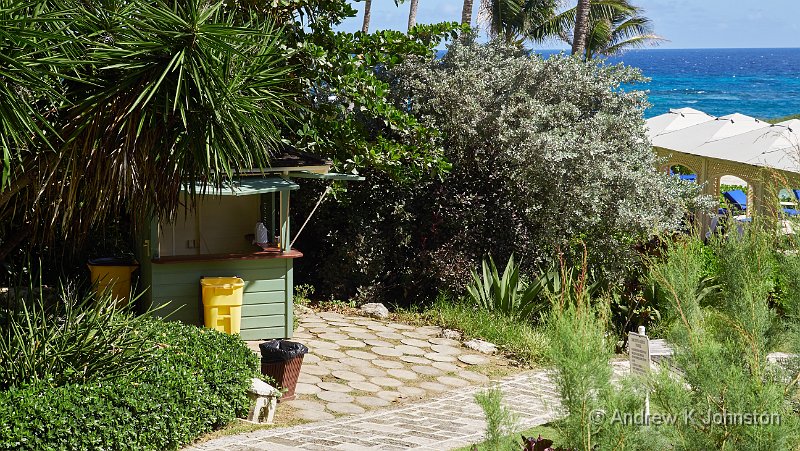
The Hut of Alleged Towels, The Crane, Barbados
Camera: Panasonic DMC-GX8 | Date: 10-11-2017 13:34 | Resolution: 5184 x 2920 | ISO: 200 | Exp. bias: -33/100 EV | Exp. Time: 1/500s | Aperture: 5.6 | Focal Length: 27.0mm | Lens: LUMIX G VARIO 12-35/F2.8

The Crane Hotel, Barbados has a hut whose purpose is to take in used beach towels, and dispense fresh ones. It has no other purpose. It is staffed during daylight hours by a helpful young chap, but on our recent visit he seemed to rarely, if ever, have any towels to dispense. Now if I was the manager and paying that chap’s salary, I would make sure enough laundry was being done to provide a reasonable supply, but then I’m weird…

We took to calling it "The Alleged Towel Hut", but then decided that was unfair. The hut itself satisfies reasonable standards of proof of its existence. The towels do not. Hence we have decided on a better term. This is now officially "The Hut of Alleged Towels". 🙂

View featured image in Album
Posted in Barbados, Thoughts on the World, Travel | Leave a comment

What Are Your Waypoints?

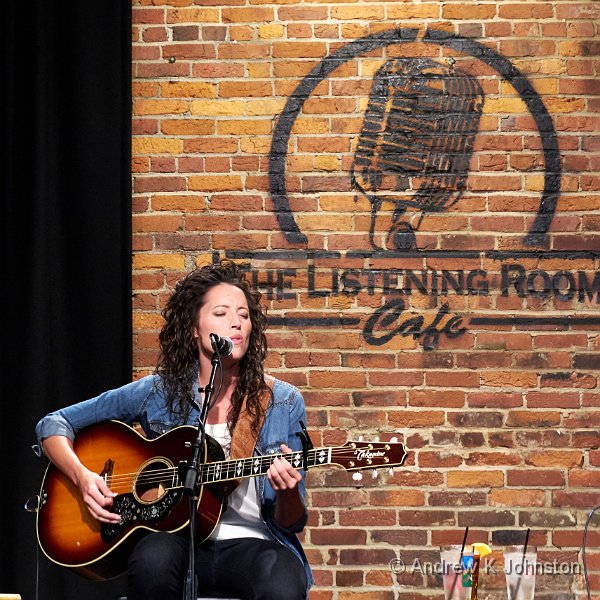
Country singer at the Listening Room, Nashville, providing important routeing information!
Camera: Panasonic DMC-GX7 | Date: 24-09-2014 18:14 | Resolution: 3424 x 3424 | ISO: 3200 | Exp. bias: 0 EV | Exp. Time: 1/25s | Aperture: 5.6 | Focal Length: 46.0mm | Location: The District | State/Province: Tennessee | See map | Lens: LUMIX G VARIO 35-100/F2.8

How do you remember the waypoints and landmarks on a journey? What are the key features by which you can replay in your mind, or to someone else, where you went and what you did?

Like any good Englishman, I can navigate substantial sections of our sceptred  isle by drinking establishment. This is, of course, a long tradition and officially recognised mechanism – it’s why British pubs have recognisable iconic signs, so that even if you were illiterate you could get yourself from inn to inn. It’s a bit more difficult today thanks to pub closures and the rise of pub chains with less distinguishable names, but it still works. Ask me to navigate you around Surrey, and there will be a lot of such landmarks in the discussion.

When I look back at other trips, especially to foreign parts, the mechanisms change. I can usually remember where I took favourite photographs, even without the GPS tagging, and I could immediately point to the locations of traumatic events whether in motion ("the Italian motorway with the big steel fences either side") or at rest ("the hotel with the sticky bathroom floor"). I also tend to hold in my head a sort of "moving map" picture of the journey’s flow, which might not be terribly accurate, but could be rendered more so quite quickly by studying a real map.

Frances, despite appearances to the contrary, navigates largely using food. Yesterday we had a typical example: "do you remember that lovely town square where we had breakfast in front of the town hall and we had to ask them whether they had real eggs because the powdered eggs were disagreeing with me? I think it was on the Washington trip." This was a challenge. "Breakfast" was probably right, so that narrowed things down a bit. "The Washington trip" was probably correct, but I have learned to treat such information with an element of caution.

At this point we had therefore to marry up two different reference systems, and try and work out where they overlapped. My first pass was to run the moving map of the Washington trip in my head, and call out the towns where we stayed. That eliminated a couple of stops, where we could both remember the breakfast arrangements (the very good restaurant at the Peaks of Otter Lodge, and a nice diner in Gatlinburg), but we were still missing an obvious match.

Then Frances said "I think we had to drive out of town for a bit because we’d had to change our route". Bingo! This now triggered the "traumatic event" register in my mind, specifically listening to a charming young lady in Nashville singing a song about the journey of a bottle of Jack Daniels, and suddenly realising I had put the wrong bloody Lynchburg on our route! Over dinner I had to do a quick replan and include Lynchburg Tennessee as well as Lynchburg Virginia in our itinerary. That meant an early start from Nashville next morning, heading south rather than directly east, and half-way to Lynchburg (the one with the Jack Daniels distillery) we stopped for breakfast because the offering at the hotel had looked very grim. Got there in the end.

(If you’re wondering, I do actually have a photographic record of this event. The young lady above is the one who sang the song with the critical routeing information.)

We’ve also had "that restaurant where we were the only white faces and the manager kept asking if we were OK" (Memphis, near Gracelands), and "that little store where they did the pulled pork sandwiches and the woman’s daughter lived in Birmingham" (Vesuvius, Virginia). In fairness to my wife, she can also accurately recall details of most of our retail transactions on each trip, including the unsuccessful ones. ("That town where we bought my Kokopeli material, and the old lady had to run across the street although there was no traffic"). Again there’s the challenge of marrying these up with my frame of reference, but the poor old lady in Cortez, Colorado, desperately trying to beat the count down timer on the pedestrian crossing, despite a traffic level of about 1 vehicle a minute, sticks in my mind as well, so that one was easy. Admittedly, I remember Cortez as "that nice town just outside Mesa Verde", but that’s me.

What’s your frame of reference?

View featured image in Album
Posted in Thoughts on the World, Travel | Leave a comment

3D Photos from Myanmar

Small temple at the Swedagon Pagoda, Yangon
Camera: Panasonic DMC-GX8 | Date: 10-02-2017 08:22 | Resolution: 5240 x 3275 | ISO: 200 | Exp. bias: 0 EV | Exp. Time: 1/80s | Aperture: 14.0 | Focal Length: 21.0mm | Location: Shwedagon Pagoda | State/Province: Wingaba, Yangon | See map | Lens: LUMIX G VARIO 12-35/F2.8

I’ve just finished processing my 3D shots from Myanmar. If you have a 3D TV or VR goggles, download a couple of the files from the following link and have a look.

https://www.andrewj.com/public/3D/

View featured image in Album
Posted in Myanmar Travel Blog, Photography, Travel | Leave a comment

Travel Blogging and Photo Editing

Weaver's hand
Camera: Panasonic DMC-GX8 | Date: 17-02-2017 11:39 | Resolution: 5184 x 3456 | ISO: 1600 | Exp. bias: -66/100 EV | Exp. Time: 1/40s | Aperture: 4.5 | Focal Length: 30.0mm | Location: Weaving village at In Paw Khone | State/Province: Inbawhkon, Shan | See map | Lens: LUMIX G VARIO 12-35/F2.8

I’ve been asked a number of times recently how I manage to write my blog during the often hectic schedule of my trips. It is sometimes a challenge, but it’s something that I want to do, and so I make it a priority for any "down time". I don’t see it as a chore, but as a way of enhancing my enjoyment, re-living the best experiences, working through any frustrations, and building valuable memories. If I’m travelling without Frances then there’s a lot of overlap with my report home, and if we’re travelling together then drafting the blog has become an enjoyable joint activity for coffee stops and dinner times.

That said, there are a few tricks to make the task manageable, and I’m happy to pass on some of those I have developed.

There’s no great magic to the writing. The main ingredient is practice. However I do spend quite a lot of time thinking through what to say about a day, trying to draft suitable paragraphs in my mind. If it was good enough for Gideon it’s good enough for me :). It is useful to capture ideas and even draft words whenever you get an opportunity, even on the go: travel time in buses and coffee stops are ideal. I just start drafting an email to myself on my phone, which can be saved at any time, reopened to add more as the day goes on, and sent before I start writing the blog.

The other important tool is a blogging app on your device which works offline and can save multiple drafts locally. I use the excellent Microsoft Live Writer on my PC, and the WordPress app on my phone and tablet, but any decent text editor would do. I would strongly counsel against trying to do travel blogging directly onto an online service – you will just be too obstructed by connectivity challenges.

Images are the other part of the equation. It’s very easy to be overwhelmed by the sheer volume of images, especially if you shoot prolifically like I tend to do, and if you have a relatively slow processing workflow. The first trick is to shoot RAW+JPG, so you always have something which you can share and post, even if it’s not perfect. As I observed in a previous post, you don’t need perfect in this context, and it would be rare if you didn’t from a day’s shooting have a least one image good enough in camera to share.

However, as long as I have at least some time, I do try to perform a basic edit (filter) on my shots, and process at least the one or two I want to publish to my blog. That requires a robust but quick and efficient workflow. Different photographers work different ways, but the following describes mine.

Importantly, I don’t use LightRoom or the image management features in Photoshop. Neither do I use Capture One’s catalogue features. All my image management takes place directly in Windows, supported by the excellent XnView and a few tools of my own making. I find that this is both quicker, and puts me in direct control of the process, rather than at the mercy of a model which might not suit.

The first step is to copy (not move) the images off the memory card. If I have only used one card in a session, I find it perfectly adequate to just connect the camera via USB – this works quite quickly, and avoids fiddling with card readers. As long as I have sufficient cards I don’t re-format them until I’m home (just in case something happens to the PC), nor do I do much in-camera deleting, which is very cumbersome.

In terms of organisation I have a top-level directory on each laptop called "Pictures" under which is a directory called "Incoming". This is synchronised across all my computers, and holds all "work in progress". Under that I have two master directories for each year or major trip, and then subdirectories for each event. So for Myanmar I will have top level directories called "Myanmar 2017" (for output files and fully-processed originals) and "Myanmar 2017 – Incoming" (for work in progress). Under the latter I would typically have a directory for the images from each day’s shooting, e.g. "Lake Inle Day 2". On the "output" side I will typically have a directory for each location, plus one for all the originals (RAW files and Capture One settings), but I could easily also end up with others for video, and particular events or topics such as the group.

Having copied the pictures over to the right working directory, I fire up XnView. The first step is to run a batch rename process which sets each image filename to my standard, which includes the date (in YYYYMMDD format), the camera and the number assigned by the camera, so all shots from a given camera will always sort alphabetically in shot order, and I can immediately see when an image was taken and on which camera. After that I run a script which moves all "multi-shot" images into sub-directories by type (I shoot panoramas, HDR, focus blends and 3D images each using a distinct custom mode on the camera) and takes these out of the main editing workflow.

The next step is to "edit" the images, by which I mean filtering out the bad, poor, and very good. Because I have JPG files for each shot, I can set XnView to sort by file type, and quickly scan all the JPG files in full screen mode, tagging each (using shortcut keys) on the following scheme:

  • Two stars means "delete". This is for images which are beyond use: out of focus, blurred, subject not fully in the frame. These will be moved to the wastebasket, and once that’s emptied, they are gone forever.
  • Three stars means "others". This is for images which are technically viable but which I don’t think merit processing. The obvious candidates are things like alternative people shots where the expressions weren’t ideal (but I have a better shot) or where I took a few slightly different compositions and some obviously don’t work. However this is also where I park duplicates or the unwanted frames from high-speed sequences. When I get home the JPGs will be deleted and the RAW files moved to an old external hard drive to free up disk space.
  • Four stars means "OK". This is for technically and compositionally adequate images, albeit which may not be the best, or may need substantial processing work.
  • Five stars means "good". These are the images which leap out at a quick viewing as "yes, that’s going to work".

Having tagged the images in the working folder, I have another script which deletes the two star images, moves the "others", and creates a .XMP file marking the five star images with a colour tag which can be read by Capture One. I can also copy the in-camera JPG versions of the 5 star images as a starting point for my portfolio, although these will be replaced by processed versions later.

The thing about the tagging process is to keep going, quickly, but err on the side of caution (so tag borderline delete as 3 star, and borderline others as 4 star). I can usually work through at an image every one or two seconds, so the first filter of an intensive shoot of 500 images takes less than 20 minutes. At this point I have typically reduced the retained images by 40-60%, but that varies by subject matter and the percentage of rejects can be much higher for challenging subjects such as high-speed action but also people other than professional models, where a lot get rejected for poor expressions. The reason I’ve chosen the image at the top is that I love trying to capture hands at work, but that’s another subject with a high "miss" rate. I also find that I fairly consistently mark about 4-5% of shots as 5 star.

I don’t just delete the "others", because there is the occasional case where my selected shot of a group turns out to have a major flaw, and it’s worth reviewing the options. More importantly, for family events, weddings and the like there’s the occasional "didn’t anyone take a picture of Aunty Ethel?" I rescued a friend of mine from a serious family bust-up when it emerged that the official photographer at his wedding hadn’t taken a single photo of my friend, the groom’s parents! On the case, I found a shot in "others" which after processing kept everyone happy.

At this point, and only then, I start up Capture One and navigate to the target working directory. It takes a minute or two to perform its first scan, and then I can change the sort order to "colour tag", and there are the best of the day’s images, right at the top of the list ready to select a couple for the blog and process them. 90% of the time I restrict processing changes to the crop and exposure (levels and curves) – I wouldn’t usually select for the blog any image needing more than that. Finish the words, and I’m ready to post my blog.

From plugging in the camera to posting typically takes around an hour. There’s some scope for multi-tasking, so I can work on the words (or get a cup of tea) while the images are downloading from the camera, or while posting the images to my website (which in my case is a separate step from posting the blog). As a by-product, I have performed my first edit on the shoot, and have more or less the best images prioritised for further processing.

And I have an enduring and sharable record of what I did on my holidays!

View featured image in Album
Posted in Myanmar Travel Blog, Photography, Thoughts on the World, Travel | Leave a comment