Category Archives: Thoughts on the World

Man At Work!

"Fifty Shades of Blue": Iceberg on the Jokullsarlon glacial lake, Iceland
Camera: Canon EOS 7D | Lens: EF70-300mm f/4-5.6 IS USM | Date: 27-08-2011 10:12 | ISO: 100 | Exp. bias: 0 EV | Exp. Time: 1/125s | Aperture: 10.0 | Focal Length: 80.0mm (~129.6mm) | Location: Breiðamerkursandur | State/Province: East | See map | Lens: Canon EF 70-300mm f/4-5.6 IS USM

Apologies to regular readers of my blog for the recent low output. I’m currently working on a major overhaul of my web site which will see it considerably modernised and should enable it to be viewed successfully on all sorts of different devices, but it does mean my time is being taken up with design and programming work rather than “content creation” at the moment… Please watch this space for further announcements.

On a positive note, if, like, me, you’ve embraced Google Currents for keeping up with your blog reading (see Keeping Current) then you may be interested to hear that “Thoughts of the World” is now published as a Google “Edition”. To subscribe and add it to Currents, just click here.

As an architect, I’m used to explaining that the world is not black and white, but has to be appreciated in shades of grey (but maybe not 50! :)). However as a photographer, I’m much more interested in other hues. The picture above is from my Iceland trip, and I call it “50 Shades of Blue”. Enjoy!

View featured image in Album
Posted in Thoughts on the World, Website & Blog | Leave a comment

Why the Galaxy Note is a Better Business Tool than the iPad

It seems barely believable that I’ve had the 10″ Galaxy Note in my hands for just four weeks. Like its smaller brother it just feels “right”, in a way the iPad failed to achieve in two years. It’s already delivering value, at a point at which the iPad was just frustrating me.

About a year ago I wrote a piece entitled “Ten Ways to Make Your iPad Work Effectively With Windows”. That was to some extent a tale of frustrations, apologies and work-arounds, and it’s time to contrast how the Android option delivers for business users in a heterogeneous environment.

Continue reading

Posted in Galaxy Note, iPad, Thoughts on the World | Leave a comment

Secret State – A Review

We’ve just finished watching Secret State, Channel 4’s latest attempt to capture the conspiracy thriller crown. It was good, but it could have been so much better. Edge of Darkness is safe for another few years…

There were some touches of genius. The plot, based on A Very English Coup cleverly wove in all our current bogeymen in a bang up to date tale featuring drone warfare, Islamic terrorists, toxic bankers, careless and callous petrochemical companies, electronic surveillance and the rest. Technology was exploited to help tell the tale, not as an end in itself. I also admired some of the direction, especially those scenes which placed Charles Dance’s Machiavellian character deliberately lurking in the background.

But ultimately it was all a bit unsatisfying. I’ve identified several reasons why, but the main reason was simply that it was too rushed. There’s clearly an optimum length for a conspiracy thriller on TV, and it’s about 6 hours run time. Edge of Darkness was 6 hour-long episodes, and so was State of Play. The first series of Homeland, was 10 episodes of about 40 minutes each (about 6.5 hours). There’s an upper limit as well: at around 8 hours Hunted was just too bloody complicated, and while a series of 24 runs much longer, at about 17 hours, they religiously change villains and threats twice a day, so we’re back to roughly the 6 hours duration for each “segment”.

By contrast, Secret State ran for less than 3 hours (ignoring adverts and the now mandatory review and preview segments), and it just wasn’t enough to properly develop the story. Instead of slowly developing understanding, you had key plot elements revealed as almost throw-away sound bites. Watching an off-air recording with Channel 4’s longer-than-American commercial breaks just increased the frustration.

In Edge of Darkness there’s a fascinating scene in which three senior policemen are waiting in a hospital for news of a suspect who chose to throw himself out of a window rather than face arrest. It runs for about 2 minutes, but the suspect’s condition, the police officers’ frustration, and the growing despair of the central character are all communicated with almost no dialogue. They act. Secret State had no time for such luxuries.

Secret State also had precious little time for character development. The central characters were all wonderfully cast, but most went nowhere – we learned nothing about them as people and little about their drivers, beliefs and agendas. Most also behaved true to the initial impression, rather than surprising us with unexpected heroism or villainy. Apart from the brilliant opening episode Charles Dance was particularly under-used.

I’m not convinced you need “Previously” segments in a four episode show. If you can’t follow something for four weeks, that’s a rather poor lookout. However it’s the “Next time” segments which really wound me up. These were full of spoilers, and totally un-necessary when the drama was already sufficiently suspenseful to make sure viewers returned. Surely the time would have been better devoted to addressing at least some of the hurried treatment?

A conspiracy thriller doesn’t need a happy ending, but it does need a satisfactory one, in which the dispositions of the main parties and issues is clearly portrayed. Secret State failed in this, with a hurried ending which left a lot of questions unanswered.

By contrast, the BBC’s best effort this year, Line of Duty followed the rules, and while it had a few annoying plot and character flaws, it ended up more satisfactory than the better plotted Secret State.

And finally, Of . It may be just coincidence, it may be the sincerest form of flattery, or an attempt to gain praise by association, but I’ve noticed that the best conspiracy thrillers all seem to have three word titles with a common middle word. I await State of Secrets or Secrets of State with anticipation – remember, you read it here first.

Posted in Reviews, Thoughts on the World | Leave a comment

Just Get on the Train!

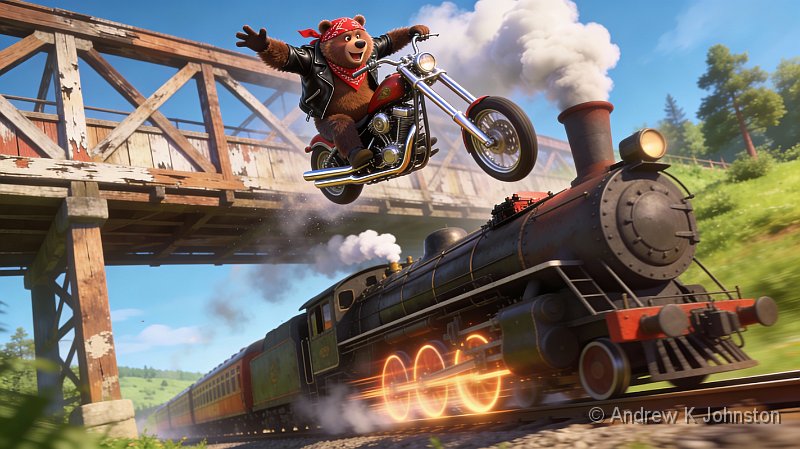
Motorcycle Bear Jumping Onto Train
Resolution: 2848 x 1600

I have decided that there are essentially two types of film or play, those which are about whether to get on the train, and those which are about how to get on the train. I don’t really like the former, but I love the latter.

OK, I know that not all films and plays involve trains, but enough do that this is a surprisingly powerful classification system.

A couple of years ago we went to see a performance of Chekhov’s Three Sisters. While I may be oversimplifying things slightly, most of the second act is the sisters talking about getting on a train. I forget the details, I think one wants to move away from the family to Moscow. I can’t even remember whether she actually gets on the train or not. Despite the fact that it was a good performance by several famous British actors, many of whose other work I love, I was bored out of my skull. Frances and I were both so affected by this, that we now have an in-joke reaction to any mention of Chekhov where one of us immediately says “just get on the —— train”.

But then I realised just how many of our favourite films do involve someone getting on a train. The key difference is that there is never any debate whatsoever about the need to do so. The challenge is how.

You may have to drive your Audi off a bridge (Transporter 3), jump from a helicopter (Under Siege 2, Broken Arrow, Unstoppable), shoot lots of bad guys first (3.10 to Yuma), jump from a camel (Sahara), talk the bad guys down (Pelham 123), jump from a car (Unstoppable, Octopussy), quietly murder some of the good guys (From Russia with Love), jump from another train (Unstoppable again, Indiana Jones and the Temple of Doom, Paddington 2, The Lone Ranger), hide in a mailbag (Live and Let Die), jump from a motorbike (Skyfall, Indiana Jones and the Dial of Destiny), run several Manhattan blocks and jump through the subway roof (Die Hard with a Vengeance), beam in (repeatedly) using a time machine (Source Code), jump from a horse (The Lone Ranger), claw into the back of the carriage with a Caterpillar digger (Skyfall again), jump from a hover-board (Back to the Future 3), couple up a car transporter (Fast Five), try and do a retinal scan from outside while the train is moving at speed, and you’re not really tall enough to reach the scanner (Mission Impossible 4), jump from a zipline tethered to the nearest alp (Captain America), lay the track as you go (The Wrong Trousers), jump into a boxcar while shackled to several other members of a chain gang (O Brother, Where Art Thou?), sneak onboard after clinging to the undercarriage (Octopussy again), jump from the subway platform (Safe, Captain Marvel, Skyfall yet again…), swing a ladder from another train (The Lone Ranger), extend a telescopic ladder from another train (Paddington 2), lasso the train while chasing it in a pump handcar (Due South, All the Queen’s Horses), jump from a bridge with a wolf in your arms (ditto), use your magnetic super-powers to latch onto the train as it goes past (X-Men Days of Future Past), leap between mine cars (Journey to the Centre of the Earth), sneak in inside a mine car full of explosive (A View to a Kill), jump from the platform of a picturesque station (Enigma), ride your motorbike off a mountain and then speed-fly with a parachute onto the train (Mission Impossible Dead Reckoning), get past the Gestapo with forged papers (The Great Escape), sneak into a train with the Turkish Nationalist Army (The Water Diviner!).

If you’re undead, you might just jump from trees alongside the track (Abraham Lincoln, Vampire Hunter), but that’s really a getting off the train film, a completely separate genre. There are also staying on the train films, such as The Wolverine. You get the picture, and I haven’t mentioned Speed, Batman Begins, UnknownGoldeneye, The Rock

So do you like stories about talking about getting on a train? Or those about doing it?


(Published June 2011, updated November 2012, July 2014, September 2014, August 2016, January 2017, April 2018, July 2018, September 2018, March 2019, January 2020, May 2020, June 2020, January 2021, January 2022, December 2023, January 2026 as the list grows…)

View featured image in Album
Posted in Thoughts on the World | Leave a comment

Keeping Current

One of the great frustrations with the iPad was that although it should have been a great blogging tool, between the limitations of available software and input processes, it just wasn’t. (See An Ideal Blogging Platform for my reflections after a couple of months of iPad ownership.)

The 10″ Note addresses all of those weaknesses, and may well become not only a primary content consumption device but also a primary platform for content creation. The available software is just better: I am writing this with the free WordPress apply for Android which just works, where the iPad version was very frustrating. Text input is quick with SwiftKey, I can multi-task with Chrome to look up previous posts, and I can easily find and add content from other sources, always a challenge in iOS land. This post has taken about 20 minutes, entirely on the Note.

I’d also like to bring your attention to a great app from Google called Currents. This takes RSS or similar feeds and turns them dynamically into an attractive “on-line magazine”. It works brilliantly with photo-rich feeds such as the photography blogs I read. Here’s what it does with “Thoughts on the World”:

image

I didn’t have to do anything with my existing feed to get this result. Currents doesn’t work in every case – if a blog starts every post with the same boring advert then it doesn’t have much to work with – but the hit rate is quite high. It is could also do with a way to mark items as read, which is a major omission. However overall Google seem to have another hit, and currently it’s free.

Blogs away!

Posted in Galaxy Note, iPad, Thoughts on the World | Leave a comment

Are There More Bricks or Photos?

Recently on The Online Photographer, I saw that in 1976 a leading commentator on photography asserted that “the world now contains more photographs than bricks.”

While I hate to be contrary (no I don’t! :)), I’m not convinced that the assertion about photographs and bricks is correct, even today. Regular readers will know I can’t resist an estimating challenge, so here goes…

Most estimates of the number of photos taken each year comes out somewhere near (but typically a bit below) one trillion, 10^12. As this number is growing exponentially, to get a total number of all photographs ever taken we can focus on recent years, and something in the range 5-10 trillion would probably cover it. However, we don’t retain all our shots. I dump about 50%. I don’t know how typical this is, but let’s use it as an estimating basis. So this gives use a number of “existing photographs” of a few (2-5) trillion.

Now bricks. This is more tricky. I estimate the number of bricks in a typical British family home at around 15-20,000. That provides shelter for an average 4-5 people, but we also spend time in other brick buildings (work, hotels, communal buildings), so let’s say 10,000 bricks per person in a “brick rich” environment like the UK.

But not everyone lives in a “brick rich” environment: for all sorts of economic, environmental and cultural reasons many buildings use other materials. So let’s assume that 10% of the world’s buildings are brick.

10,000 (bricks per person) x 10% & 7 x 10^9 (people) = 7 x 10^12 bricks. That’s still a couple of times greater than my estimate of the number of photos…

Now obviously as the numbers are (surprisingly) so similar and the number of photos is growing exponentially, the roles will soon be reversed. But I don’t think it was true in 1976.

Posted in Photography, Thoughts on the World | Leave a comment

Action At A Distance

I have just read three cracking thrillers: Nothing to Lose, written by Lee Child in 2008, Zero Day, written by Mark Russinovich in 2011, and Perishable Goods, written by Dornford Yates in 1928. All three are great yarns, and well worth a read. If you would not discover some or all of these any other way, please feel free to take this as a recommendation.
Each book is a child of its time. In Zero Day the heroes battle a devastating Al Quaeda cyber attack on the west. The plot of Nothing to Lose is also about religious extremism and 21st century geo-politics, although from a very different standpoint.
There’s a refreshing lack of religious extremism and geo-politics in Perishable Goods. Chandos & co have to rescue a kidnapped friend from villains who are motivated purely by money and personal revenge. The book wears its 80+ years very well, although some of the writing, attitudes and technology are now amusing. (My favourites, slightly paraphrased, “I was totally alone…, except of course for my manservant” and “after a few minutes the cars were started and ready to move”).
From this you might conclude that the two recent novels are similar, and Yates’ very different, but that’s not correct. It’s actually Zero Day which is the odd one out. The others are both personal battles, largely on a scale where all the protagonists physically interact with one another. Zero Day inhabits a much larger canvas, in which the key players have no such interaction, and portrays a frightening vision in which misfits in odd corners of the world working for small financial rewards can unwittingly create genuine weapons of mass destruction. This anonymous “action at a distance” is genuinely scary, not least because it could really happen, it might even be in progress today.
I enjoyed all three books, but Zero Day really made me think.

Posted in Reviews, Thoughts on the World | Leave a comment

Jon Lord RIP

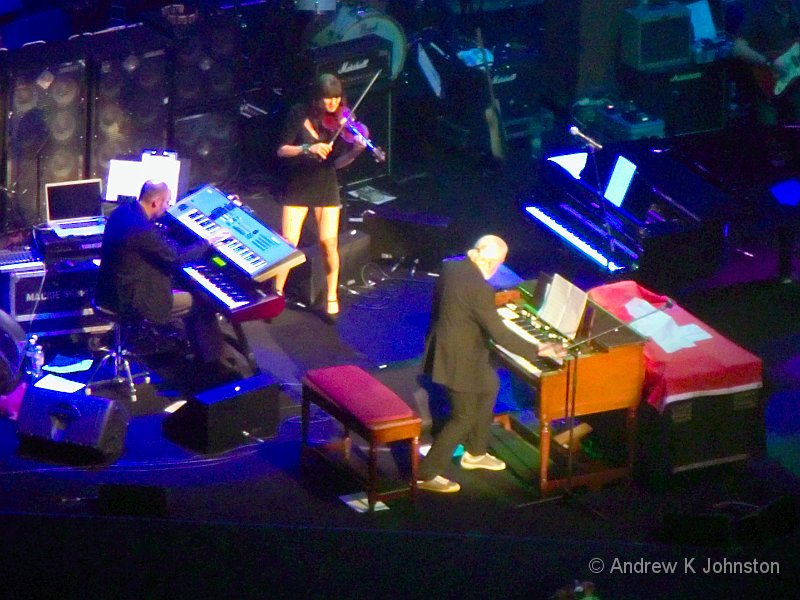
The late Jon Lord and the very talented Anna Phoebe performing a spine-chilling version of Sarabande at Superjam in the Albert Hall, July 2012
Camera: Canon PowerShot S95 | Date: 08-07-2011 22:45 | ISO: 800 | Exp. bias: -1 EV | Exp. Time: 1/20s | Aperture: 4.9 | Focal Length: 22.5mm | Lens: Canon EF-S 10-22mm f/3.5-4.5 USM

Since I was first old enough to take an interest in “real” (heavy/prog) rock music, my favourite band has been Deep Purple. I can honestly say I’ve studied their music (my relationship with it goes a long way past just listening), and seen them several times. Like the other great bands of the era their music has a unique “fingerprint”, unmistakeable for any other. In Purple’s case, it was the inclusion of a Hammond Organ, driven by a man who was both a great rocker and equally an orchestral composer. That was Jon Lord. I read sadly of his passing yesterday. He was a lovely man, and a great musician, and will be sorely missed.

I saw him in concert only twice, but both provide strong memories. The first time I saw Deep Purple, in 2002, he had already retired and handed the Hammond over to Don Airey. Half way through the first half of the concert, Airey did a long organ solo, which went at one point to a single note, while he was lit by a single lamp fading slowly to black. The note continued, and the lights came up, to reveal Jon Lord at the keyboard instead. The house erupted with admiration, possibly the greatest outpouring of emotion at a single musician’s appearance I have ever experienced.

Then just over a year ago, we attended the Superjam charity concert hosted by Deep Purple at the Royal Albert Hall (see here for my review). Pride of place in the first half was an appearance by Jon Lord. His set included an absolutely chilling rendition of Sarabande with the violinist Anna Phoebe, a couple of duets with Rick Wakeman, and a final ensemble where they were joined by two more keyboard players, including Gary Brooker of Procul Harum fame.

I will play his music tomorrow, and think of him with some sadness, but mainly with great thanks for how his music has enriched my life.

View featured image in Album
Posted in Thoughts on the World | Leave a comment

Finally, Something Smaller

Detail from the side of Shakespeare's birthplace, Stratford-on-Avon
Camera: Panasonic DMC-GH2 | Date: 27-06-2012 19:24 | ISO: 400 | Exp. bias: 0 EV | Exp. Time: 1/1300s | Aperture: 8.0 | Focal Length: 42.0mm | Lens: LUMIX G VARIO PZ 14-42/F3.5-5.6

First Impressions of the Panasonic GH2

Regular readers will know that technology miniaturisation has been on something of a negative trend chez Johnston. My most recent TV, desktop, main camera and most notably laptop purchases have all been significantly larger and heavier than their predecessors. Even my latest phone, purchased a few weeks ago, is rather larger than the previous one, although there’s no real weight penalty.

However, I’ve finally bucked the trend. Recovering from knee surgery (which limits my carrying ability), and thinking about my next holiday under the cloud of increasingly challenging airline luggage limits, I’ve taken the plunge and invested in an EVIL camera (“Electronic Viewfinder, Interchangeable Lens”:) ), in the shape of a Panasonic GH2. It’s funny how several influences came together:

  • A very good Panasonic cinema advertising campaign featuring a professional taking great shots in Yosemite, using a Panasonic G3,
  • Rave reviews of the new OM-D,
  • A growing desire on my part to get a new toy and kick-start my slightly stuck photographic activities.

I had a look at the OM-D, but it just didn’t fit my hand. Oddly the Panasonic G3, almost identical in size, felt fine, but came up short on spec. A bit of research suggested that the GH2 would be a better match for my needs – a similar package, but closer to my Canons in capability. However, what really swung it was a review by Michael “Luminous Landscape” Reichmann, a man who apparently thinks nothing of spending £10k on the latest medium format wonder, who used a GH2 as his main camera for a six-month stay in Mexico last winter. Sold!

It’s been in my hands a few days now, and so far I’m very impressed. In terms of functionality, it’s closer to my Canon 7D than anything else in my fleet. There are proper knobs and switches for all the major functions, but also a comprehensive set of custom functions and buttons (the lack of which is one of the things which would make the Canon 60D a poor replacement for my much-loved 40D). Handling will take a little getting used to, but it all makes sense and with a bit of practice should work by feel with the camera up to the eye – very much my preferred mode. The electronic viewfinder is very clear, now I’ve got it focused at a point which works for my eyes with glasses either on or off!

The camera is rich in features with some, like the ability to change the aspect ratio in camera, potentially very useful. However, it has to be said that neither Canon nor Panasonic have made any progress against my list of enhancements we really need in DSLRs. Let’s hope the next generation do better, and in the meantime I’m off to investigate the growing phenomenon of GH2 “hacking”…

Image quality is really very good. Despite the smaller sensor noise levels are similar to my Canon 7D, certainly up to ISO 1600. I haven’t played with the really high ISOs yet. Beyond that is the performance of the 14-42mm “power zoom”. This comes in a package which when switched off looks like one of Panasonic’s tiny “pancake” primes, but extends when powered up to provide a useful zoom with 28-84mm range (in 35mm equivalent terms). It’s pretty sharp throughout its range, and chromatic and geometric aberrations seem to be almost absent. This conflicts sharply with the Canon EF-S mid-range zooms: the 17-85mm suffers very bad CA, the 15-85mm has very noticeable geometric distortion for a large part of the “wide” end, and neither is very sharp at the edges of the frame. Admittedly the Canon lenses have almost twice the zoom range, but I’d much rather have a really good 15-45mm “L” zoom, if only Canon made one… 🙁

All this comes in a tiny package. The camera is just about as small as it can be and fit my hands. Powered off, it’s about 3″ deep. And the body plus standard zoom is less than 500g. That’s about 40% of the weight of the Canon 7D + 15-85mm combo, or less than that lens alone. I suspect a “three zooms plus fast prime” lens set will probably still weigh less than the 7D and standard zoom lens, and not cost much more.

Now I don’t know how reliable it will be, or how it will stand up to regular use. The current version couldn’t compete with the 7D for fast action, or in very low light, although the gap is narrowing with each generation of these new mirrorless, smaller sensor cameras. Whether there’s a case for the 550D is more questionable. Will I dump my Canons for the GH2? Not yet, but it feels like the writing may be on the wall…

Update, September 2012

The apparent excellent performance of the tiny MFT lenses is due to in-camera correction of the JPG files. The RAW data shows the geometric challenges of such lenses in their full light. If you are prepared to use either SilkyPix or Adobe LightRoom as your RAW processor, then it will automatically read the correction data and re-apply it, but this is not available to users, like me, of other RAW processors. I’m becoming slightly obsessed by this problem, and now running a project to try and get to grips with it. However, I thought it worth updating my original post with this note. If you shoot JPG, then the MFT cameras are little short of amazing. If you shoot RAW, be prepared for a bit of a challenge…

View featured image in Album
Posted in Micro Four Thirds, Photography, Thoughts on the World | Leave a comment

Did I Speak Too Soon?

After pride comes the fall. My upbeat post yesterday about the Galaxy Note was slightly premature, as I suddenly ran slap bang into a problem with calendar synchronisation.

It turns out my phone was upgraded on Thursday to Android 4.0 (resplendent in the code name “Ice Cream Sandwich”) which has a serious bug causing calendar sync to fail if you have appointments which repeat indefinitely, like birthdays, not exactly an uncommon situation. How Google have released an OS with such a major and far-reaching bug is a real puzzle.

However, the good news is that armed with a copy of the log file viewer aLogcat, and a PC browser where you can quickly update the properties of your appointments, it’s fairly quickly resolved. If the equivalent problem arose on the iPad you’d be stuck.

I guess I just have to avoid tempting fate like that…

Posted in Galaxy Note, Thoughts on the World | Leave a comment

Notes on the Note

I have just taken delivery of my brand new Samsung Galaxy Note, and I must say so far I’m very pleased. After the rather aggravating experience of the iPad I was a bit wary of going to another new operating system, but Android is nowhere so “alien” as iOS.

In many ways this is a more direct successor to my much-loved HP iPaqs than a current Windows phone. First, you can drive it with a stylus, which I find dramatically more efficient and accurate on a small device. You can choose and customise input methods, and they then work everywhere. I’ve found an excellent keyboard with predictive text called Swiftkey, but the standard keyboard, Swype and voice dictation work as well. It has a proper file system, so file management is independent of the application, and both USB and cloud solutions work with minimal effort.

Getting my applications in order has also not been too painful. Many of my favourites from my Windows devices have Android equivalents, so I quickly implemented OneNote, TreNotes and several others. There’s an Android version of SoftMaker Office, so no repeat of the iPad problems with Office files, although I’m not convinced the Android version as mature as the Windows Mobile one. The “missing” sync function for Outlook was a bit puzzling, but I discovered that I already owned some software (Sync2) which syncs Outlook to Google, solving that problem.

The main “serious” app challenge was password management. CodeWallet Pro no longer exists, and while SafeWallet is a reasonable replacement transferring the data was not trivial. However an hour with a bunch of different text editors and manually converting a flat text export file into an XML import seems to have worked.

Sadly, my favourite games are a different matter. Very few seem to have made the transition to Android. Common choices like Sodoku will be fine, but I may have to bid farewell to others.

Downsides? Not many. Yes, it’s very big for a phone, but not big enough to displace the iPad, although it may relegate the Kindle to sunny day duty. Battery life may be poorer than either the iPad or HTC Touch HD2, but should still do a day of heavy use, or two days of lighter duties.

It’s going to take a little while to get completely to grips with a whole new OS, but so far I’m amazed how quickly and smoothly things have gone. Wish me luck!

Posted in Galaxy Note, iPad, Thoughts on the World | Leave a comment

Break Compatibility, Lose Loyalty

For almost 20 years I have been a fan of, and borderline apologist for, Microsoft. One of the main reasons was their focus on software usability, backed up by a visible intention to preserve backwards compatibility wherever possible. While each new release of Windows, Office, IE and Visual Studio brought new features, these were by and large an extension to rather than a replacement for that which already worked. When a compatibility break was absolutely necessary, such as with the transition to VB.NET, it was well signposted and the option to parallel run the old version well supported.

Sometime around 2007-8, maybe by coincidence just when Bill Gates retired, this all went to hell in a handcart, and since then I’ve been cursing new Microsoft software versions as much as praising them. Each release has brought frustrations, and in many cases they have been sufficiently severe to drive me to adopt a competitor’s product, or at least a third party add-on.

XP SP 2 broke WMA format so it is incompatible with most third party players. My car was new in 2008, but I have to rip CDs using an XP SP1 virtual machine. Vista broke the reliable and flexible ntbackup. It took a bit of effort to get it working again, and it’s still part of my (more complex) backup strategy, but the “heavy lifting” is now done by Acronis rather than Windows.

The disruptive user interface and file format changes of Office 2007 have been widely discussed elsewhere. Suffice to say that I never used Office 2007, and run Office 2010 only with a third party add-on which restores the old menus. The compatibility-breaking changes to follow up flags in Outlook 2010 are extremely annoying, but as yet insufficient to drive me to an alternative product.

The same is not true of the changes to Virtual Machine support in Windows 7. Before that move, I used Mirosoft’s own Virtual PC extensively. However, the loss of compatibility, features and reliability were so severe that I now only use and recommend VMWare WorkStation/Player for this purpose. You can read about my experiences here.

The latest problem, and what has prompted this blog, is the appalling state of Internet Explorer 9. I have been a faithful user of IE since V1, and have lived, fairly happily, with its limitations through to IE8. However, since “upgrading” to IE9 I have become completely disillusioned, because it just isn’t reliable enough. Here are a sample of the things which just don’t work properly:

  • Downloading dynamically-generated PDF files, such as bills from BT,
  • MasterCard SecureCard authentication. This one’s a real pain if you’re at the end of a long online purchase, and you find your main credit card won’t work,
  • The combined address / Google search bar. If I type in a valid www…. address, I expect the browser to at least attempt to use it , not do a search!
  • Printing. Some long text pages, especially from typepad blogs, get mashed with the main font/character set replaced by something unreadable,
  • Rendering some web sites readably at all. Some of the worst offenders, ironically, are Microsoft’s own “support” forums.

By direct contrast, Google Chrome seems to do a decent job of all the above. I am hereby announcing my intention to make it my primary browser whenever I have a choice.

I’m now really scared about Windows 8, with it’s so far half-hearted changes to the desktop. What will that wreck?

Now in fairness, Microsoft are not the only, or maybe even the worst offenders in this space. For example Bibble/Corel have just pushed through a change to their AfterShot Pro software which no-one wanted and which breaks a plugin I’ve written, and I suspect in that community I have some influence to say “the new version is broken, don’t use it.”

I really don’t understand Microsoft’s behaviour here. Are all these compatibility wrecks conscious decisions? If so, do the conquest sales related to cool new features really outweigh the loss of loyalty from existing users? If not, have they just got lazy and complacent? Who knows?

Posted in Agile & Architecture, Thoughts on the World, VMWare | 1 Comment