Category Archives: Thoughts on the World

Break Compatibility, Lose Loyalty

For almost 20 years I have been a fan of, and borderline apologist for, Microsoft. One of the main reasons was their focus on software usability, backed up by a visible intention to preserve backwards compatibility wherever possible. While each new release of Windows, Office, IE and Visual Studio brought new features, these were by and large an extension to rather than a replacement for that which already worked. When a compatibility break was absolutely necessary, such as with the transition to VB.NET, it was well signposted and the option to parallel run the old version well supported.

Sometime around 2007-8, maybe by coincidence just when Bill Gates retired, this all went to hell in a handcart, and since then I’ve been cursing new Microsoft software versions as much as praising them. Each release has brought frustrations, and in many cases they have been sufficiently severe to drive me to adopt a competitor’s product, or at least a third party add-on.

XP SP 2 broke WMA format so it is incompatible with most third party players. My car was new in 2008, but I have to rip CDs using an XP SP1 virtual machine. Vista broke the reliable and flexible ntbackup. It took a bit of effort to get it working again, and it’s still part of my (more complex) backup strategy, but the “heavy lifting” is now done by Acronis rather than Windows.

The disruptive user interface and file format changes of Office 2007 have been widely discussed elsewhere. Suffice to say that I never used Office 2007, and run Office 2010 only with a third party add-on which restores the old menus. The compatibility-breaking changes to follow up flags in Outlook 2010 are extremely annoying, but as yet insufficient to drive me to an alternative product.

The same is not true of the changes to Virtual Machine support in Windows 7. Before that move, I used Mirosoft’s own Virtual PC extensively. However, the loss of compatibility, features and reliability were so severe that I now only use and recommend VMWare WorkStation/Player for this purpose. You can read about my experiences here.

The latest problem, and what has prompted this blog, is the appalling state of Internet Explorer 9. I have been a faithful user of IE since V1, and have lived, fairly happily, with its limitations through to IE8. However, since “upgrading” to IE9 I have become completely disillusioned, because it just isn’t reliable enough. Here are a sample of the things which just don’t work properly:

  • Downloading dynamically-generated PDF files, such as bills from BT,
  • MasterCard SecureCard authentication. This one’s a real pain if you’re at the end of a long online purchase, and you find your main credit card won’t work,
  • The combined address / Google search bar. If I type in a valid www…. address, I expect the browser to at least attempt to use it , not do a search!
  • Printing. Some long text pages, especially from typepad blogs, get mashed with the main font/character set replaced by something unreadable,
  • Rendering some web sites readably at all. Some of the worst offenders, ironically, are Microsoft’s own “support” forums.

By direct contrast, Google Chrome seems to do a decent job of all the above. I am hereby announcing my intention to make it my primary browser whenever I have a choice.

I’m now really scared about Windows 8, with it’s so far half-hearted changes to the desktop. What will that wreck?

Now in fairness, Microsoft are not the only, or maybe even the worst offenders in this space. For example Bibble/Corel have just pushed through a change to their AfterShot Pro software which no-one wanted and which breaks a plugin I’ve written, and I suspect in that community I have some influence to say “the new version is broken, don’t use it.”

I really don’t understand Microsoft’s behaviour here. Are all these compatibility wrecks conscious decisions? If so, do the conquest sales related to cool new features really outweigh the loss of loyalty from existing users? If not, have they just got lazy and complacent? Who knows?

Posted in Agile & Architecture, Thoughts on the World, VMWare | 1 Comment

Macs Are Really Easy? Ha!

There is a myth. The myth goes “Windows is complicated. Macs are really easy – they just work.”

Like most myths this may have started from an original truth, but is now a lie. I am it’s latest, but I suspect far from only, victim.

Let me explain. For over a year now I have been developing a plugin for the RAW developer Bibble and it’s recent successor, Corel AfterShot. These plugins are developed using c++ and the Nokia QT framework, which theoretically allows the same code and user interface design to compile and run on Windows, Linux and Mac.

As a died in the wool Windows developer, that’s where I started. There’s a QT add-in to Visual Studio, so with a bit of juggling I managed to get one of the examples to load into VS, build, and run using Bibble as the target executable, and I was off. I was on a fairly steep learning curve in respect of the programming model, but I had very few problems compiling and running things.

When it got to the stage that I had something to share with the Bibble community I published the Windows version, and another member of the community kindly cross- compiled for the other platforms. There was another learning curve to make sure my code compiled cleanly on the other platforms, but nothing too drastic. For over a year I sent code updates to Jonathan, and got compiled Linux and Mac libraries back.

Although Jonathan still provides a very helpful service, it became apparent that if I wanted to have full control over the application versions I support, and be able to verify my plugin’s portability, I needed the ability to compile and run each version myself. I wasn’t prepared to buy and carry extra hardware around, but maybe VM technology would work.

I started with Linux. I had a couple of false starts but quickly found a site which has pre-built VMs for most Linux distributions (http://www.trendsigma.net/vmware/), and homed in on Lubuntu – based on Ubuntu but with a quite Windows-like shell. I downloaded and installed AfterShot and QT Creator, loaded up a copy of my code, and clicked “build”. And it worked first time! Getting a completely slick solution took a bit more effort, but it works so well I don’t now even copy the Windows code, I just open the same directory from my Linux VM and run the Linux builds in place.

So far so good. Now for the Mac. What could go wrong?

Continue reading

Posted in Code & Development, Thoughts on the World, VMWare | Leave a comment

Vernal Greetings

Butterfly at the Royal Horticultural Society Gardens, Wisley
Camera: Canon EOS 7D | Lens: EF-S15-85mm f/3.5-5.6 IS USM | Date: 04-02-2011 14:41 | ISO: 400 | Exp. bias: 0 EV | Exp. Time: 1/30s | Aperture: 7.1 | Focal Length: 85.0mm (~137.7mm) | Lens: Canon EF-S 15-85mm f3.5-5.6 IS USM

To celebrate the Vernal Equinox and the unseasonably pleasant weather we’ve had in the UK for the last two weeks, I thought it would be a good idea to post a nice Spring picture. By coincidence I’ve been processing some shots from a trip to the Royal Horticultural Society Gardens at Wisley, more or less a year ago. However, with the late Spring last year most of my best flower shots are of tropical orchids, which would be cheating, so instead here’s a butterfly!

View featured image in Album
Posted in Thoughts on the World | Leave a comment

Mac OSX–A Third-Class OS?

A recent post on The Online Photographer (More Planned Obsolescence: Evil Lion) really chimed with me. Apple’s implacable opposition to virtualisation is a significant opportunity lost.

I’m a Windows user, spending much of the working week away from home. I get a vast amount of value from virtualisation. It allows me to carry just one PC with multiple “client specific” images, and enables me to keep running legacy software almost indefinitely. My main client uses the same technology to provide legacy support for essential software, which in long-cycle engineering businesses can easily be 20-30 years old, as physical assets in such businesses age many times more slowly than the computing equipment around them.

I also develop plugins for the Bibble RAW processor. The same code should work on Windows, Mac and Linux, but you have to compile and test on each platform to confirm this. I’ve recently added a Linux Virtual Machine to my kit. This was remarkably painless, just a few hours work, and I can now rapidly cross-compile and test my Windows-based developments under Linux. If there’s an issue which means having to support more than one flavour or version of Linux adding it would be trivial.

I just can’t do this for the Mac. I don’t want to buy and carry another laptop (which would be useless for any other purpose), and you can’t get virtualised OSX, either as a VM or as a service, through any legal and “safe” route. The result: as far as I am concerned OSX is a “third-class” OS, almost a “technical ghetto”, and I have to rely on the good offices of other developers to deliver my plugins for it.

People will put up with a lot in the name of love. Maybe Mac users “love” their computers enough to tolerate this behaviour. But looking in from outside I find Apple’s attitude perplexing and very annoying.

See http://theonlinephotographer.typepad.com/the_online_photographer/2012/02/more-planned-obsolescence-evil-lion.html
Posted in Code & Development, PCs/Laptops, Thoughts on the World, VMWare | 1 Comment

Tyranny of the Colour Blind

Shot at the Botanical Gardens near Chania, Crete. I don't know what this plant is, and judging from the four or five different colours for its fruit, I'm not sure it does either! However, the world is definitely richer for the splashes of colour...
Camera: Canon EOS 7D | Lens: EF-S17-85mm f/4-5.6 IS USM | Date: 08-10-2010 09:02 | ISO: 200 | Exp. bias: 0 EV | Exp. Time: 1/80s | Aperture: 9.0 | Focal Length: 59.0mm (~95.6mm) | Lens: Canon EF-S 17-85mm f4-5.6 IS USM

Or Have Microsoft Lost Their Mojo?

I like colour. I see in colour, dream in colour and have a rich colour vocabulary which drives much of my photographic style (see Seeing in Black and White). It’s also an important part of how I work – colour can be a powerful “dimension” in the visualisation of information. The human eye and brain are remarkably good at processing and using colour signals, whether it’s a highlighted line of text on screen, or a flashing blue light in traffic.

Now I acknowledge that this isn’t universal. As a designer you have to cater for a significant proportion of users (about 8% of males) who have poorer colour vision, and especially in mobile systems there will be times when ambient lighting conditions reduce effective colour saturation to a point where it doesn’t work. The traditional way to deal with this is to combine colour with another signal, such as shape – green tick vs red cross, for example. Then each user can use the signal which works best for them.

Microsoft used to get this. Their software was frequently a model of usability, and exploited colour, shape and shading to both guide the user, and allow the user to better manage their data. Icons could be rapidly located by colour as much as by detail. Data items of a particular status would “leap out” from a forest of those without the status marking. Office 2003 introduced follow-up flags for both OneNote and Outlook, which proved to be a great way to identify and retrieve key items in large lists. These supported both colour and shape or text as “identifying dimensions”.

Then sometime in the late noughties, Microsoft lost their way. Office 2010 has abandoned colour as a navigational tool. Tools, icons and the dividers between sections of the screen are all subtle shades or pale pastels, making them very difficult to visually distinguish, particularly in poor lighting conditions. Icons are no longer clearly distinguishable. However the worst regression is in respect of Outlook’s follow-up flags, which now actively disable the use of colour via a tyranically imposed colour scheme consisting of “multiple shades of puce”, rendering them completely useless for their original purpose.

This rant had been brewing for some time as I try to get to grips with Office 2010 and its inexplicable abandonment of many well-established user interface standards at the cost of enormous frustration for long-standing users. What tipped me over the edge was the announcement last week of Microsoft’s new Windows logo. Gone are the cheerful primary colours, and the careful shading which made later versions pop out of the screen with real depth. In their place is a plain white cross on a muddy blue background. Useless!

Now I suppose there might be people who think that this reduced colour palette is somehow “cool” or “elegant”. They’re probably the same group who think that it’s appropriate to model fashion on anorexic teenagers rather than real women. In both cases they’ve clearly lost track of who their real customers are, who has to get real utility from their work.

I’m not against change, and I accept that high-resolution graphics allows more subtle designs that we were previously used to. However, this rush to abandon colour in user interfaces and branding robs us of an important dimension. We absolutely do have to make sure that designs are also usable for users and in conditions where colour may not work, but we must not throw away or disable powerful tools which have real value to the majority of us. Microsoft should know better.

View featured image in Album
Posted in Agile & Architecture, Thoughts on the World | Comments Off on Tyranny of the Colour Blind

Ten Ways to Make Your iPad Work Effectively With Windows – Update

Microsoft have released an arguably belated but nonetheless very welcome version of OneNote optimised for the iPad and with very good synchronisation to the PC. It’s not perfect, but it’s good enough that I’ve updated my guidance on how to make your iPad work effectively with Windows.

– Posted using BlogPress from my iPad

Read the full article
Posted in iPad, Thoughts on the World | Leave a comment

Ten Ways to Make Your iPad Work Effectively With Windows

If you’re one of those people who uses loads of Apple products, and is thinking of proposing Steve Jobs for canonisation, then you may be happy with how your iPad works, but if you’re trying to make it work effectively in a Windows-based environment you may have found shortcomings with the “out of the box” solutions.

It is perfectly possible to make the iPad play nicely as part of a professional Windows-based environment, but you do have to be prepared to grab the bull by the horns, dump most of the built-in apps (which are almost all pretty useless), and take control of both file management and communications via partner applications on the PC. This article presents some of my hard-won tips and recommendations on how to do this and get productive work out of the iPad’s great hardware.

Read the full article
Posted in Agile & Architecture, iPad, Thoughts on the World | Tagged | 3 Comments

I Thought They Were Supposed To Be Getting Smaller?

I’m in the process of replacing my laptop, and yet again finding that the alleged miniaturisation and convergence of digital solutions is nothing more than a figment of marketeers’ fevered imaginations. I suppose that after the experience of my last desktop replacement (see here) I should have expected nothing more, but hope springs eternal…

I’ve been very happy with my 15″ Toshiba Satellite Pro, new in early 2009, but recently it’s been showing some signs of reaching the end of its economic life, plus the way I now develop my photographs is very compute-intensive, and a faster device would speed that activity up considerably. I also find that the relatively slow single 2.5″ disk leads to very slow startup times and virtual machine operations, both of which slow down my professional use.

Thus my first decision was that my new device should support an Intel Core-i7 processor and 64-bit Windows, at least 8GB RAM and ideally have solid state disks, at least for the boot drive.

The next driver was forced on me by the vagaries of the market. Prior to 2007, most laptops had a 4:3 (=16:12) aspect ratio, but suddenly the market decided that all laptops should be “widescreen”, with a 16:10 aspect ratio. This was great for viewing movies, but meant that for a given diagonal size the new devices were more than 10% smaller than before. Not much good if you’re working on text documents (usually of vertical orientation), or digital images with <3:2 aspect ratio, which is most of them… That’s one reason why my next laptop went from 12″ to 15″, just to maintain the vertical size of the display.

Now they’ve done it again! Almost all new laptops have a 16:9 aspect ratio, which means a further reduction of about 8% screen height for a given diagonal size. This is a right royal pain in the neck, particularly as it is typically accompanied by an increase in pixel resolution, which combine to make text and icons much smaller, just as I’m getting to that age where my eyes are starting to change, and slightly larger text would work better. There are other disadvantages too: a given laptop model is around 8% longer than it’s predecessor, so it may not even fit in the same bag.

This all appears to be driven by fashion, and targeted solely at those who watch movies on their laptops. The goal appears to be “true HD”, and hang the consequences. After some brainstorming, I can only think of three things short wide screens are good for:

  1. Watching films
  2. Browsing spreadsheets or other tables with lots of columns
  3. Working on photographic panoramas

On the other hand, they are much worse for:

  1. Reading and writing documents (most pages are portrait orientation, and the human eye has problems tracking across very long lines of text)
  2. Developing – you want to see plenty of lines of code and diagnostics, and most lines of well-written code are quite short
  3. Working on any normal image, especially if it’s portrait orientation
  4. Working with any application which has multiple top and bottom toolbars, or a Microsoft “ribbon”
  5. Everything else…

So where does this put my laptop choice? After rather more agonising than usual, I’ve gone for a desktop, or should that just be “desk”, replacement system :), an Alienware M17x. This is very fast, has the usual stunning Alienware looks, and importantly supports dual disks, with a highly-rated quality screen. The screen is just slightly taller than the Toshiba, but the laptop is a full 5cm wider, and over 1kg heavier. It’s a good computer, but portability is definitely down a notch. The thing which makes it feasible, of course, is the iPad, which now fills the role of the portable, meeting-friendly launch to the Alienware cruiser. Admittedly carrying two devices increases the weight of my computer bag, but usually only until I have decanted the laptop into its base location for the day, and maybe it justifies the weight training…

Thus far, I’m impressed with the beast. CPU performance is certainly as expected, and I’m pleasantly surprised by battery life, at almost 5 hours in light usage. This makes up for the fact that the main power supply is about the size of a house brick, and although the laptop will run off a smaller Dell supply, it won’t charge the battery. On the disk side I’ve installed a Seagate Momentus hybrid drive as the secondary data drive, and that seems to be working well, but my first attempt to install the SSD for the boot drive didn’t work, so that’s still pending. What is annoying is that like all my previous laptops, the LCD panel is nowhere near correct colour calibration with the default profile, so I have to sort that out before serious photographic use. Further updates will follow…

To wrap up, here’s the potted history of my laptops since I started buying my own, and why:

  • 1999-2001: Compaq Presario with 12″ screen. Worked for VB development and general office use, but slow
  • 2001-4: Dell Latitude LS400 with 10″ screen. I got the “light, portable” bug, and this little laptop fitted the bill, even if I did have to haul a separate CD drive and floppy drive around. It was good on the move, but never quick and I worked off an external screen when I could.
  • 2004-6: Toshiba Portege M200 with 12″ screen. The first decent convertible tablet, great in meetings (in tablet mode), and decent for development although you had to be patient…
  • 2006-9: Toshiba Portege M400: The only time I’ve done a straight upgrade, this was basically the M200 with built in CD and a dual core processor. CPU performance was fine, I/O was very limited. However, the thing which really started to frustrate me was the difficulty of getting accurate colours on the screen.
  • 2009-11: Toshiba Satellite Pro A300, 15″ screen. With the change of aspect ratios, I had to go to 15″ to get a screen as “tall” as the 12″ of the Porteges. This workhorse has served very well, it’s fairly light, and only the most extreme image processing or virtual machine work exceeded its abilities.
  • 2011-: Alienware M17x. Fast, elegant, and just about preserves the important vertical dimenion of the screen! Also heavy and expensive… The jury’s out.

Has anyone else noticed or suffered from this odd trend?

Posted in PCs/Laptops, Thoughts on the World, VMWare | Leave a comment

What Are The Chances Of That?

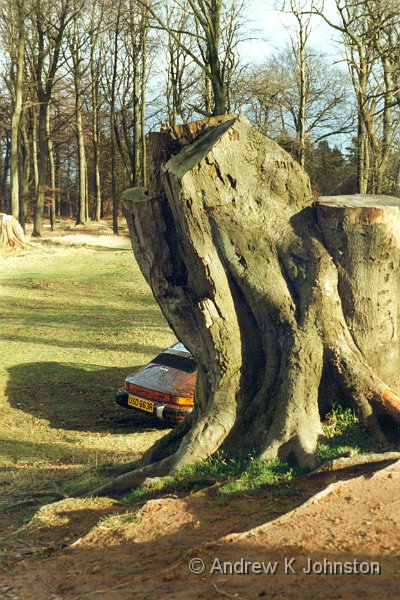
"Helga", my Porsche 911, behind a tree
Resolution: 1247 x 1870

For the last couple of years, I’ve been working fairly regularly with a chap called Carl. The other day a group of us were chatting, and got to talking about cars we had owned. Among others, Carl had once owned a very souped-up Ford Escort. To explain how fast it was, he pointed out that he’d once “burned off a Porsche” in it.

My ears pricked up, and I interjected “You know, that once happened to me in my Porsche. I was at a set of traffic lights just outside Croydon, and some imp in a mark I Escort pulled up alongside, turned to me with a very cheeky grin, and then left me standing when the lights went green.”

And Carl said “The Sutton bypass. About 1987. Tobacco brown 911 with no rear wing.”

Yes. We were describing the same event from opposite sides of the dotted White line. It was him!

———————

We all occasionally experience odd coincidences, but this has to be a pretty wild one by any standards. It got me thinking – what are the chances of re-encountering someone from an anonymous past event like this?

I reckon that a significant part of the British population have timelines which will never intersect mine at first or even second hand. However between places I have lived and worked, places with which I have family, friend or work connections, events I attend and routes I travel the number of intersections in a lifetime (counting any individual once) must be quite large. Let’s say it’s 10 million. This includes “knows someone I know” and “in the same place at the same time” as well as more direct interactions.

Now I also reckon that I work with perhaps 20 or 30 people at any one time closely enough to have such a conversation, and that group changes at a rate of perhaps 10 people a year. Others might put the figure higher, but let’s use that for now. Therefore since 1987 maybe 250 people have added to that group.

It’s therefore very easy to come up with a crude estimate of the probability that some individual I crossed in my youth would end up working with me, at about 250 in 10,000,000, or 1 in 40,000. That’s about half the chance of winning £10 with a three number match in the British lottery.

However, that’s just the “latent coincidence probability”. You then have to factor in the chance of actually discovering it.

To come up in conversation at a range of 24 years an event has to be pretty memorable to at least one party, and recognisable to another. Trivial or indistinct events get forgotten. I suspect our traffic lights grand prix was one of many for both Carl and myself in our youth, but it’s memorable as the one in which the ancient Escort beat the (almost equally ancient) Porsche, in a way which left my friend and I in my car laughing rather than anything else. I have forgotten almost all the others, where Helga did what Porsche built her to do, and won.

There’s also an upper limit on memorability. If events are too dramatic or tragic they will also preclude conversation.

Even if you have a history of memorable events, they may just not come up in conversation. Carl and I have worked together for a couple of years, and not discussed old cars before. The topic could easily have come up when I was not in the room, or just not listening, and not been repeated.

These factors are more difficult to quantify, but I reckon there’s probably only a 1 in 100 to 1000 chance of discovering the co-incidence at the 24 year range of my example. So for a single event involving just one other main party we have a net probability of the order of 1 in 10 million that I’ll work with that other party, and then discover it. That’s about the same as winning the UK lottery jackpot!

Three factors make things more likely. Obviously if more than one other person was involved this increases the probability proportionately. There’s also a smaller than 10 million group of people whose paths are likely to cross several times because of location or other factors.

You also have to consider that most people have a pool of such events to draw on. We’re talking about events which would merit a special mention in the pub, a couple of paragraphs in the letter home, maybe a blog rather than just a tweet in today’s parlance. I reckon I accumulate these at the rate of one every few weeks. Therefore since my memory became really active, I have maybe 40×25 such events, a convenient 1000 to draw on.

Thus the probability for a given event is ~ 1 in 10 million, but the probability of any such coincidence drops back to ~ 1 in 10 thousand, and maybe down to 1 in a thousand for events based on a home location, a favourite sport or similar.

Now I reckon I’ve had a couple of such coincidences in my career. There are three possibilities: either my calculations are wrong, I’ve set the bar for what counts too low (increasing the number of potential events), or I’m just very lucky.

What do you think?

View featured image in Album
Posted in Thoughts on the World | Leave a comment

Not from My Cold, Dead Hand…

My regular correspondent Malachy Martin recently posed another of his “research” questions:

What would work look like if you only had an iPad as your computing device?

My first reactions focused on whether my iPad could replace my laptop. Then I had a horrible second thought:

“I hope he doesn’t mean taking away my phone!”

I suppose I could go back to carrying a separate phone (or bag of 20p pieces), diary, address book, alarm clock, notepad, dictaphone, GPS, map, camera (well, I do do that, but that’s different), puzzle book, music player…

Yes, the iPad can do all of these, but it’s just too big to carry around all the time. I’m certainly not going to strap it to my arm in the gym, or hold it to my ear in public. So let’s assume I’m allowed to keep my phone, and focus on my first interpretation of the question. Could the iPad replace my laptop? What couldn’t I do without the latter?

First, say goodbye to a lot of content creation. The iPad touch keyboard is just too slow and inaccurate for entering large amounts of text. The ZaggMate keyboard which comes combined with a cover for the iPad screen is great, and at least allows you to navigate and select text accurately, but it suffers from some nasty key bounce and the keys are a bit too small for my fingers. Even ignoring physical text entry problems, you’ve got the challenge that there’s no truly compatible version of MS Office for the iPad, so creating properly compatible structured Office documents is almost impossible.

The problem is even worse in respect of graphical content. Set aside the fact that I do a lot of image processing on my laptop, which requires both substantial horsepower and a proper PC-level operating system. The iPad just doesn’t hack it for fine graphical manipulation. I can reliably drive a PC with a mouse to an accuracy of 1-2 pixels (in 1280 on my laptop, and 1600 on my desktop). The iPad is designed for operation with a 1/2″ paintbrush, and is realistically limited to operations suited to such a tool.

I do a lot of development work, with 2 full scale databases, 2 web servers, various modelling tools, a Java development environment and no fewer than 6 versions of Visual Studio on my laptop, plus a couple of virtualised alternative PC operating systems. That’s not going to work on my iPad! I could cheat and move to “thin client” (Remote Desktop) access to the equivalent running on a server somewhere, but that would function only when I’m connected (I’m often not when I want to do such work), and the navigation and text entry limitations of the iPad would drive me bonkers.

Even for general “office” work the limitations of iOS would rapidly challenge my sanity and productivity. For example, when I’m developing complex documents I do a lot of multi-tasking, working across multiple open documents each of which needs to be in a fixed known state under my control. I also make a lot of use of drag & drop and working with multiple windows visible at once.

The other big problem is iOS’ lack of content management separate from the “apps”. I manage about 200GB of “content” on my laptop: client files, my own documents, photos, technical library, publications etc. This is all synchronized to the big desktop/server at home, but available offline. The thought of all of this being tangled up with individual applications is just horrific.

So no thank you Malachy, the iPad isn’t going to replace the laptop or the phone any time soon. Now if someone can come up with a Windows 7/8 slate with the same performance and capacity as my laptop, and the same battery life as my iPad, and capable of operation with either a finger or a stylus…

Posted in iPad, PCs/Laptops, Thoughts on the World, VMWare | Leave a comment

Turning Points

A regular correspondent of mine just posed an interesting question: “The Web has significantly evolved over the past 15 years. What have been the major milestones in the web’s evolution either in business or technology?”


That’s quite a big question… 🙂  I didn’t have time for a detailed answer, but came up with the following main “turning points”:

  • 1996-7: The “ubiquitous web” becomes useful. This was the point at which someone with an average PC and dial-up connection could perform real tasks as well as or better than going to a traditional intermediary, e.g. for booking holidays.
  • c2003: Composite applications and services start to become a reality (e.g. Amazon marketplaces). This required a number of technological advances (RSS, web services), but also a shift from human-computer to computer-computer interactions. I was never completely convinced about “web 2.0”, but in hindsight I suppose this was what it meant.
  • c2005: The web becomes “the main way of doing things” for things like banking, tax & interactions with the government. Before that date I was often frustrated either by not being able to use the web, or frustrated because of the services’ limitations. Since that sort of date I’ve only had to perform a handful of such transactions by other means, and they’ve usually been a disaster!
  • c2009-10: The web starts to deliver on the mobile “information everywhere” vision, as per things like Bill Gates’ The Road Ahead. It’s the confluence of decent large-screen hardware, standards-based services and well-designed apps. Put it another way – this was the point at which the computing in Star Trek, the Next Generation started to look out of date, just as the original series did by 1987.

I’m aware that this is very focused on practical, e-commerce type uses. I’m not personally convinced that social networking represents a watershed in itself, rather than another exploitation dimension, which probably has a very similar set of milestones. The same is probably true of several other content / application areas.

What do you think? Have I nailed it, or have I missed a big one?

Posted in Thoughts on the World | Leave a comment

…And Then Three Come Along All At Once

Jon Lord and Rick Wakeman perform "It's not as big as it was" at Superjam 2011
Camera: Canon PowerShot S95 | Date: 08-07-2011 23:03 | ISO: 800 | Exp. bias: -2 EV | Exp. Time: 1/40s | Aperture: 4.9 | Focal Length: 22.5mm | Location: Upper Rissington | State/Province: England | See map | Lens: Canon EF-S 10-22mm f/3.5-4.5 USM

Reflections on an excellent Summer for live music

I understand why buses come in threes. If you’re interested, it’s simply because the one at the front does most of the picking up and setting down, and the others just catch up. However, I don’t understand why live music appears to work the same way.

We normally manage at least a couple of “big” concerts each year, but we didn’t find much to inspire us in the whole of 2010. Then suddenly the famine turned to feast, and between the beginning of March and the end of July I’ll have managed a total of nine live music events! These have really covered the range: from reggae to rock, from a tiny dinner jazz gathering with two musicians to the extravagant production of Roger Waters The Wall, and from classic rock acts to classical violin.

By very weird coincidence having never seen any of the classic American rock bands apart from Chicago, we then added four more scalps in three weeks. Journey, Foreigner and Styx (see this post) were followed in short order by Toto, at the much better venue of the Hammersmith Apollo. This was an excellent concert, and the youngsters now fronting up Journey would do well to go and view the older masters at work. All the great hits, good interaction with the audience and each other, and a decent sound mix. That’s how it should be done.

However, the best of the lot, heading rapidly for a place in my all time top ten, was also one of the oddest. Superjam 2011 at the Royal Albert Hall last week was a charity concert in aid of Great Ormond Street Children’s Hospital. The organiser is one Jackie Paice, wife of Ian, so naturally the music revolved around Deep Purple and their friends. And what a bunch of reprobates turned up…

After a lengthy charity auction (where those of us in the cheap seats got to have a distant look at the sort of people who can splash out 20 grand in a good cause) the music got going at about 9.30. The first act set the tone for the evening, with Newton Faulkener doing a version of Bohemian Rhapsody, complete with the complicated bits, as a solo with just an acoustic guitar. Various guests followed, each doing their own party piece, typically a tribute to another great musician, alongside one of their own works. Joe Bonamassa did a great version of BB King’s The Thrill is Gone, and Gary Brooker turned up with Good Golly Miss Molly, followed, of course by Whiter Shade of Pale, which I certainly never expected to hear live by the original singer.

At this point there were still two Hammond organs and a big bank of synthesisers sitting unused on the stage, but that was about to be rectified. First by Jon Lord, who after a rocky first number then produced a spine-tingling version of Sarabande, with the both talented and attractive young violinist Anna Phoebe, and then an ethereal version of his ballad Pictured Within. Jon handed over to Rick Wakeman, who amused us with variations on Eleanor Rigby in the style of Prokofiev, as only he can, and then brought Jon Lord back on for a duet for Hammond organ and synths. This work, composed for the concert, was humorously about two old men comparing their “organs”, with the wonderful title It’s Not As Big As It Was :). Finally everyone came back on stage for the first half finale, Life On Mars, which Rick Wakeman apparently co-wrote with David Bowie.

After a short break, the second half started with Bill Bailey doing a very funny, but very odd, act with a six-neck guitar (!), followed by an even odder, even funnier medley of rock anthems in the style of Chas and Dave. At last Deep Purple took the stage, and belted through several of their classics. They were characteristically generous to the younger musicians, including Joe Bonamassa coming on guest guitarist on Maybe I’m A Leo.

But they left the best till last. The finale was Deep Purple doing Smoke On The Water – “nothing new there” I hear you say, but wait … – with Bill Bailey out front playing the infamous riff – on a set of cow bells! Musically spot on, and very possibly the funniest live music performance I have every seen. 😀

Maybe this wasn’t the most polished set of performances ever, and maybe the sound quality up in the back row of “the gods” wasn’t the greatest, but who cares? The music was stirring, the evident friendships and goodwill heartwarming, and I laughed like a drain. If there’s a better way to raise some money for a good cause I’m not sure I’ve experienced it.

Location:Bicester,United Kingdom

View featured image in Album
Posted in Reviews, Thoughts on the World | Leave a comment