Blog Views
Categories
Reviews by Content
Archives
- May 2012 (1)
- April 2012 (7)
- March 2012 (5)
- February 2012 (3)
- January 2012 (1)
- December 2011 (3)
- November 2011 (3)
- October 2011 (3)
- September 2011 (5)
- August 2011 (26)
- July 2011 (6)
- June 2011 (8)
- May 2011 (6)
- April 2011 (9)
- March 2011 (6)
- February 2011 (7)
- January 2011 (6)
- December 2010 (5)
- November 2010 (22)
- October 2010 (5)
- September 2010 (4)
- August 2010 (4)
- July 2010 (5)
- June 2010 (4)
- May 2010 (3)
- April 2010 (1)
- March 2010 (1)
- February 2010 (2)
- January 2010 (4)
- December 2009 (1)
- June 2009 (1)
- May 2009 (1)
- April 2009 (2)
- March 2009 (1)
- November 2008 (2)
- July 2008 (2)
- June 2008 (1)
- April 2008 (1)
- January 2008 (1)
- July 2007 (2)
- June 2007 (1)
- April 2007 (4)
- March 2007 (1)
- October 2006 (2)
- June 2006 (1)
- May 2006 (2)
- March 2006 (1)
- January 2006 (3)
- August 2005 (5)
- July 2005 (5)
- June 2005 (5)
- May 2005 (6)
- March 2005 (9)
- February 2005 (5)
- September 2004 (2)
- June 2004 (1)
- May 2004 (2)
- April 2004 (1)
- March 2004 (2)
- December 2003 (1)
- September 2003 (1)
- August 2003 (2)
- July 2003 (4)
- June 2003 (1)
- April 2003 (2)
- March 2003 (2)
- July 2002 (1)
- June 2002 (2)
- April 2002 (9)
- January 2002 (1)
- September 2001 (1)
Category Archives: Photography
Something Fast, Something VERY Slow

| 1110 7D 3174 | Restful moggie - Vinales, Cuba |
| Camera: Canon EOS 7D | Date: 18-11-2010 20:18 | ISO: 200 | Exp. Mode: Aperture priority | Exp. bias: 0 EV | Exp. Time: 1/125s | Aperture: 10.0 | Focal Length: 50.0mm | Lens: Canon EF-S 15-85mm f3.5-5.6 IS USM |
After an inevitable delay while I set up my new PC, I’m finally back to sorting out some images. The new beast certainly does what I wanted it to. Processing an 18MP RAW file on the old laptop took up to 30s, now it’s less than 3!
I’m not a “cat person”. Whereas dogs are usually very docile around me cats are usually plain hostile, and even the friendlier ones usually make a bee-line for my scrotum with their claws… However, this moggie in Cuba wasn’t doing anyone any harm, and I liked both the “through the keyhole” effect and the restful colour palette in this shot. I hope it also lowers your pulse by a bpm or two.
Posted in Cuba Travel Blog, Photography
Leave a comment
Simply the Best!

| 0911 7D 9111 | Guests at the wedding of my friends Anna and Adam. Simply the best! |
| Camera: Canon EOS 7D | Date: 24-09-2011 22:30 | ISO: 400 | Exp. Mode: Program normal | Exp. bias: -2/3 EV | Exp. Time: 1/60s | Aperture: 5.6 | Focal Length: 68.0mm | Lens: Canon EF-S 17-85mm f4-5.6 IS USM |
Not a lot to say about this one – it just made me giggle when I was reviewing the photos from a wedding I attended last weekend. Enjoy
Posted in Humour, Photography
Leave a comment
That Shouldn’t Have Worked…

| 0811 7D 7952 | Mountain stream at Graenfjall, Iceland |
| Camera: Canon EOS 7D | Date: 26-08-2011 16:21 | ISO: 100 | Exp. Mode: Aperture priority | Exp. bias: 0 EV | Exp. Time: 1/5s | Aperture: 14.0 | Focal Length: 26.0mm | Latitude: N 63°58'58.33" | Longitude: W 18°46'28.05" | Altitude: 613 metres | Country: Iceland | Lens: Canon EF-S 17-85mm f4-5.6 IS USM |
There’s a lovely moment in the film Sahara where Pitt and Giordano are following a typically desperate plan in the hope that if they can kill the villain his men will just surrender and lay down their arms. When, to their surprise, this starts to happen they look at each other and say simultaneously “That shouldn’t have worked…”. This is the photographic equivalent.
There are two schools of thought on how you should photograph moving water. One approach is to use a fast shutter speed and “freeze” the motion. I’m convinced that this is the best approach for large waterfalls, fast rivers or large waves, and you’ll see it in many of my photographs. As long as there’s enough light then there’s no major technical challenge with that approach.
The opposing school of thought is that you use a very slow shutter speed (typically a large fraction of 1s) and show the water as a blur. This expresses the direction of motion, but personally I don’t think it expresses the force or the dynamics so well. However, as Iceland has almost as many waterfalls as Venice has gondolas (see “Waterfalls, Waterfalls…”) I decided that this was an ideal opportunity to experiment.
I’ve come to the conclusion that the slow shutter speed approach does work, but it works best for small features with complex flow patterns, but relatively low flow speed/force. I’ve also reached the conclusion that a lazy man will work harder to avoid work than to actually do the job!
Here’s the official, recommended method to get a shot like the above:
- Pre-visualise the result you want, ideally using a cardboard rectangle instead of actually looking through your camera’s viewfinder.
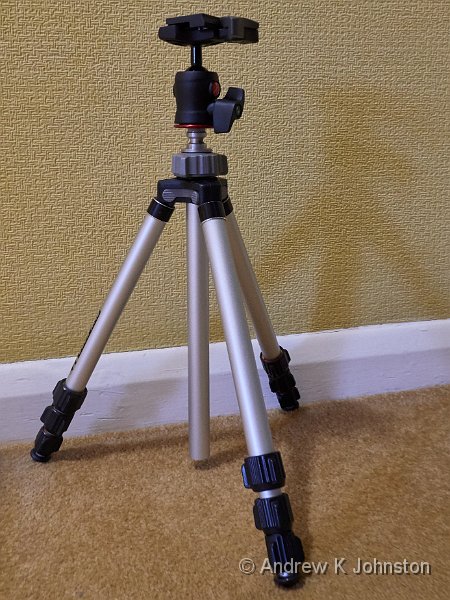
- Set up your tripod. The heavier this is the better. If the waterfall is a long way from the road be grateful for the exercise.
- Curse when you realise that to position the tripod correctly either it, or you, are going to get very wet.
- Turn off image stabilisation, and mount your camera on the tripod. Attach the remote release.
- Fine tune the camera and tripod position to get the composition right. Curse when more of your kit gets wet.
- Set the exposure to get a shutter speed of 1/4 to 1s. Start by selecting the lowest ISO and a small aperture (say f22). If this isn’t enough, attach a polariser. If this is still not enough, take out the Lee/Cokin filter kit, mount up the filter holder, and slide in your neutral density filter(s).
- Meter carefully. Typically the highlights will be very bright if there’s any direct sunlight, and automatic metering may either over-expose or under-expose depending on how much of the scene is bright water relative to the rest.
- Take the shot.
In fairness, this method works well, even if your photography costs $10 a shot and you don’t see the results until six weeks after leaving the location. However, here is the alternative Andrew Johnston Patent Digital Method:
- Wander over to the interesting waterfall, and decide that this is one you want to photograph with blurred movement.
- Realise that it’s a long walk back to the jeep, and you can’t be ****d to get your tripod. Anyway, where you want to stand it would only get wet…
- Set your camera to its lowest ISO, aperture priority and a high aperture. On an APS-C DSLR you probably don’t want to go much higher than f16 as diffraction effects start to kick in.
- Make sure image stabilisation is on. If you want to control reflections and highlights attach a polariser and get it set right.
- Take a quick shot to check exposure. Dial in exposure compensation as required.
- If the resulting shutter speed is in the region of 1/10s – 1/4s you’re probably OK. If it’s too low, just reduce the aperture. If it’s still too high, take the ND filter out of the filter pack.
- Realise that the Cokin filter holder is in your other camera bag, which is in the jeep. See point 2. So don’t worry about the holder.
- Hold your camera firmly in your right hand. Hold the filter in the left hand, in front of the lens.
- Fine tune the composition, breathe in, and take the shot. Check the sharpness of the static elements on the LCD. If they are sharp enough then you’re done, if not go to step 8 and try again.
OK, if I’d had my Cokin filter holder in my bag I would have screwed it onto the front of the lens, which would at least have allowed me to brace my camera with both hands. What’s interesting is that Image Stabilisation technology is good enough that you can get decent hand-held shots at this shutter speed, and immediate digital review allows you to check their sharpness.
Next week – how to induce temporary paralysis so you can hand-hold for 25s for fireworks!
Posted in Iceland Travel Blog, Photography
Leave a comment
Iceland Photography Tips – A Spare Everything!
| Steamed | "Steamed" - action shot of the author, by James Chambers |
| Resolution: 531 x 397 |
Iceland is a great place for photography, but you need to be properly prepared to get the best of it, and not come away disappointed.
First, unless you’re very good at research, navigation and off-road driving, you need a guide. Sure, you can get to the well-known sites a short drive from Reykjavik or along the coast road under your own steam, but you’ll miss many of the most stunning locations in the interior. However, if you want to spend serious time on your photography you need to be with a group, and guides, who understand your needs. I can’t praise highly enough the great service I had from first contact with Nature Explorer. Hawk and Finn are both great company, skilful drivers, knowledgeable and entertaining guides, and impressive photographers in their own right. Their administrative staff are also excellent, and their resilience to problems comforting. I’m very happy to recommend them.
Next, dump your preconceptions. Even short distances or intervals bring dramatic variation in scenery, weather and lighting. Well known sites may be quite crowded, or almost empty. A classic view may disappoint, and then half an hour later a less obvious subject may be portfolio material. Dedicated dawn-watchers may disagree, but in my view timing isn’t critical – “golden hour” extends well into the morning and from late afternoon, but more importantly the quality of your light is much more likely to be controlled by the weather than the hour. Iceland rewards being prepared more than missing breakfast and supper.
Protect your kit well, and carry spares for everything! Iceland is a harsh environment. You’ll be doing long distances on rough roads. The volcanic dust and ash gets everywhere, and is very abrasive. You will end up soaked by rain, waterfalls and geysirs (in my case, “all of the above”;)). The failure of my 15-85mm lens wasn’t the only hardware problem in our group, although the others were mainly more minor problems with things like batteries, filters, lens caps and retaining rings. Several cameras gained battle scars from knocks and falls. I also managed to destroy a pair of trousers and gave up on a faulty battery. Nature Explorer even had to resort to a spare super-jeep!
As a minimum, make sure you have a second camera body and a second “standard” lens (whatever that means for you). My cheaper Canon 17-85mm lens rescued my trip. Consider carrying three batteries for your main body in case one dies as happened to me. Also remember one of the hidden advantages of using mid-range Canon kit – someone else in the group may be able to help. You will end up shooting in wet or dusty conditions, so a Kata Rain Bag or similar, and cheap filters you don’t mind wiping with anything to hand are both essential!
Iceland is cold, but it’s not the temperature that gets you (for our trip it was consistently above freezing and up to 14C), it’s the wind. The answer is lots of layers. For me the combination of sweatshirt, microfibre jacket with detachable lining, warm hat and raincoat with hood was about right, but others might need even more. I can also recommend carrying a flask of coffee. I ended up buying one on the first day, and leaving it behind, and had to haggle with hoteliers a couple of times about filling it, but it was well worth the effort.
Deep pockets are useful in two different ways. In a practical sense they are a great solution to the ridiculous baggage limits airlines are progressively imposing. If you can shove a couple of lenses into your trousers and heavy batteries into your jacket then the baggage allowances become less of a problem.
In the metaphorical sense you need to be prepared for high prices – Iceland isn’t cheap, especially by the standards of say the USA or southern Europe. That said, by UK standards and given the current exchange rate it didn’t feel that bad. I will comment on the recommendation made by almost every web site and guide book to buy lots of booze at the incoming duty free store. I’m now convinced this is a con trick to get free beer for Icelanders. Unless you’re a real alky, don’t bother.
Don’t expect to get anything done on the go. I had visions of sitting in the jeeps reading, writing my blog on my iPad, or at least preparing for the next location, but despite Finn being a very smooth driver this was absolutely impossible – the roads are just too rough. Not for nothing does my map of Iceland have a road classification I have never seen before: “main road – unsurfaced”.
Be prepared for all photographic opportunities, and for lots of shooting. Although my Canon 7D got most use, the 550D also came into its own for wandering around Reykjavik, and I always had the S95 in my pocket for the unexpected. I shot at every focal length from 10mm to 300mm, and at every speed from 25s for the fireworks to 8 fps for the puffins in flight. I photographed landscapes, buildings, people and action. By the end of the trip I had exceeded my Cuba shooting total, having exposed around 2100 frames, with ~1150 (~30GB) retained for further processing after initial filtering. I used about 56GB of CF cards, plus a small amount on 2 8GB SD cards for the two smaller cameras.
There’s a saying “chance favours the prepared mind”. If that’s ever true, it’s true of photographing Iceland.
If you want to see more of my Iceland photography blog, or get a few specific location ideas, please go to www.andrewj.com/blog/iceland
Posted in Iceland Travel Blog, Photography, Travel
Leave a comment
Back to the Street

| 1110 7D 3753 | Woman keeping car safe inside in Trinidad, Cuba |
| Camera: Canon EOS 7D | Date: 21-11-2010 18:19 | ISO: 100 | Exp. Mode: Aperture priority | Exp. bias: 0 EV | Exp. Time: 1/15s | Aperture: 9.0 | Focal Length: 28.0mm | Latitude: N 21°48'15.24" | Longitude: W 79°59'5.37" | Country: Cuba | Lens: Canon EF-S 15-85mm f3.5-5.6 IS USM |
After a week of beautiful but desolate landscapes in Iceland, I fancied a bit of colour and vibrance from Cuba. This was the first shot in the list, and a bit intriguing. It’s definitely one way of keeping your car out of harm’s way!
Posted in Cuba Travel Blog, Photography, Travel
Leave a comment
Shoot Only Puffins, Leave Only Footprints

| 0811 7D 8521 | Puffin in flight at Dyrholaey, Iceland |
| Camera: Canon EOS 7D | Date: 28-08-2011 13:15 | ISO: 200 | Exp. Mode: Shutter priority | Exp. bias: 0 EV | Exp. Time: 1/320s | Aperture: 6.3 | Focal Length: 180.0mm | Latitude: N 63°25'4.93" | Longitude: W 19°2'48.67" | Altitude: 46 metres | Country: Iceland | Lens: Canon EF 70-300mm f/4-5.6 IS USM |
I was ready for a quiet day of mainly driving on Sunday. I was also ready to report a total of about 1800 shots taken, which is a bit lower than for the Cuba trip, not unreasonable given the slightly shorter duration and the fact that this was mainly landscape photography.
Then we got to the puffin colony…
Having visited a couple of interesting rock formations (basically basalt columns like Staffa or The Giant’s Causeway), we drove a short distance to the top of the cliff, which was essentially home to thousands of puffins, which were variously sitting quietly or diving off into the sea to catch food. They seem to be quite unafraid of humans, and because of the prevailing wind onto the cliff they had to glide slowly at take-off and landing, sometimes very close to us, which made photography feasible, if still challenging.
Of course, this is what my kit, consisting of the Canon 7D and 70-300 IS lens, is built for. Any minor inferiority complex relative to the 5D and medium format brigade vanished in the face of my 8 frames per second and high performance auto-focus, and I got a number of good shots. The above is probably one of the best, although there are several other good candidates.
It did put the shooting total up a bit. In less than an hour I took well over 300 shots, filling a 16GB memory card and flattening a battery, but who cares. Together with the other shots from the day the total now stands over 2150 – even higher than Cuba!
Our hosts had organised a wonderful end to the day. In the outskirts of Reykjavik we diverted to the hospital where Gruni (Finn’s wife, who had joined us on the tour) works. There we were doubly treated, both to a celebratory glass of champagne and a couple of chocolates, but also to an exhibition of the best of Finn’s photographs, in wonderful large prints. Definitely something to aspire to.
I’m back in the hotel, and busy packing for an early start. I’ll do a final post when I’m home, summing up and listing my tips for any future travellers, but it’s been a wonderful trip and highly recommended to anyone else who wants to try.
Posted in Iceland Travel Blog, Photography, Travel
Leave a comment
Fire and Ice – Delivered

| 0811 7D 8205 | Fireworks over the Jokulsarlon glacial lagoon, Iceland |
| Camera: Canon EOS 7D | Date: 27-08-2011 23:13 | ISO: 200 | Exp. Mode: Manual control | Exp. bias: 0 EV | Exp. Time: 8.0s | Aperture: 8.0 | Focal Length: 13.0mm | Latitude: N 63°59'32.08" | Longitude: W 16°54'11.97" | Altitude: 105 metres | Country: Iceland | Lens: Canon EF-S 10-22mm f/3.5-4.5 USM |
Saturday was when our tour really delivered on its “fire and ice” moniker. We started the day at the Jokulsarlon glacial lagoon, where an edge of the enormous Vatnajokull glacier calves off into the sea. Whereas 100 years ago this was happening quite close to the sea’s edge, the point at which the icebergs fall from the glacial edge has progressively moved back, and they now fall into a lagoon of mixed salt and freshwater where they tend to hang around for a few days before drifting out to sea. Apparently the edge of the glacier is retreating by a massive 200m per year (due more to the effect of the incoming salt water than global warming), making this the fastest-changing glacier in Europe.
This has famously been used as the location for two Bond films, most notably the car chase in Die Another Day. The problem is that due to all the salt water, it doesn’t usually freeze even in mid-Winter. So they temporarily blocked up the lagoon outlet to stop extra salt water coming in, and waited three weeks for the lagoon to freeze. Why they couldn’t just find a suitable frozen lake somewhere is a good question, so far unanswered.
It is a very dramatic location for photography, with all the shapes and colours in the ice, and under constant change as the ice moves, often twisting and tumbling suddenly as the balance of the mass above and below the surface changes.
After lunch we headed up the coast via another, much calmer glacial lagoon to a waterfall surrounded by basalt columns. Unfortunately we got there just the same time as a bus load of grockles who all wanted to sit right in the middle of the stream for about 1/2 hour having their photos taken… Grr
The last stop before dinner was a quick walk up alongside the glacial tongue right behind our hotel. This was useful to get a sense of the enormous scale of these, and then try and imagine that each is only a tiny corner of Vatnajokull.
After dinner it was back to Jokullsarlon for the “fire” part of the day – a once a year fireworks display over the lagoon. This was brilliant, and I hope I’ve done it justice.
Sadly, it’s the long drive back to Reykjavik tomorrow, with limited photography, and then home. However, it’s been a wonderful trip, with an amazing and unexpected variety.
Posted in Iceland Travel Blog, Photography, Travel
Leave a comment
Floating Ice

| 0811 7D 7993 | Iceberg at Jokullsarlon, Iceland |
| Camera: Canon EOS 7D | Date: 27-08-2011 10:06 | ISO: 100 | Exp. Mode: Aperture priority | Exp. bias: 0 EV | Exp. Time: 1/250s | Aperture: 10.0 | Focal Length: 180.0mm | Latitude: N 64°2'35.69" | Longitude: W 16°16'34.76" | Altitude: 15 metres | Country: Iceland | Lens: Canon EF 70-300mm f/4-5.6 IS USM |
This is a small iceberg floating in the Jokullsarlon galcial lagoon – see post above for details.
Posted in Iceland Travel Blog, Photography, Travel
Leave a comment
One from the Road

| 0811 7D 7979 | An edge of the Vatnajokull glacier reflected in a pond |
| Camera: Canon EOS 7D | Date: 27-08-2011 09:30 | ISO: 100 | Exp. Mode: Aperture priority | Exp. bias: -2/3 EV | Exp. Time: 1/60s | Aperture: 10.0 | Focal Length: 47.0mm | Latitude: N 64°2'27.27" | Longitude: W 16°18'11.43" | Altitude: 19 metres | Country: Iceland | Lens: Canon EF-S 17-85mm f4-5.6 IS USM |
Saturday consisted of various views of the Vatnajokull glacier. Here’s one taken by shouting “stop” at Finn when we saw a puddle which reflected this glacial tongue in good light. Thankfully his quick reactions didn’t cause an accident.
Posted in Iceland Travel Blog, Photography, Travel
Leave a comment
Also from the “Foss a Siva”

| 0811 7D 7971 | Hut adjacent to the Foss a Siva waterfall, Iceland |
| Camera: Canon EOS 7D | Date: 26-08-2011 18:12 | ISO: 100 | Exp. Mode: Aperture priority | Exp. bias: -2/3 EV | Exp. Time: 1/25s | Aperture: 10.0 | Focal Length: 28.0mm | Latitude: N 63°40'28.62" | Longitude: W 18°25'32.43" | Altitude: 74 metres | Country: Iceland | Lens: Canon EF-S 17-85mm f4-5.6 IS USM |
Here’s another view of the field beneath the Foss a Siva. I loved the light, and the simple colour palette, and just wanted to share this with you.
Posted in Iceland Travel Blog, Photography, Travel
Leave a comment