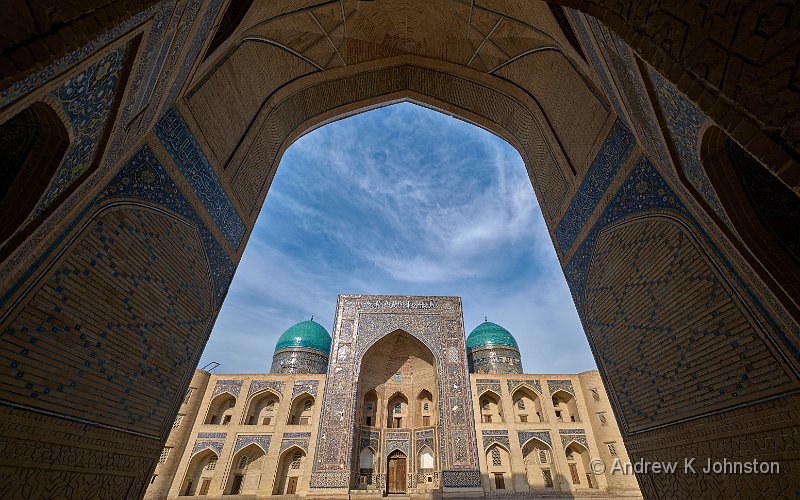
| Poy Kalan religious complex, Bukhara | |
| Camera: Panasonic DC-S5 | Date: 25-05-2026 17:54 | Resolution: 6210 x 3881 | ISO: 100 | Exp. bias: -66/100 EV | Exp. Time: 1/400s | Aperture: 9.0 | Focal Length: 14.0mm | Location: Bukhara Market | State/Province: Bukhara, Bukhara | See map | Lens: LUMIX S 14-28/F4-5.6 | |
Our day starts with the long drive from Samarkand to Bukhara. As I now expect, it’s a modern, divided multi-lane highway. There are no craters (so a distinct notch up on Mongolia) although in places the surface has been repaired badly and bouncy progress means I have to abandon typing my blog. The road is open to all traffic, which means fast electric cars mixing with donkey carts. Direction of travel is observed, but not necessarily lane control and it’s a bit disconcerting to see the fast cars and large trucks all moving to the right to pass a donkey cart, or lad on a bike, in what would normally be the "fast" lane.
I am impressed how clean the road is. There are regular roadside bins, clearly both used and reliably emptied. If you look carefully you see the odd abandoned bottle or packet, but none of the dreadful rubbish you usually see roadside in countries both poor and richer.
What is noticeable is the number of abandoned or incomplete roadside services. This looks suspiciously like what happened as Britain’s road network expanded in the 1960s – a large number of people invested in facilities in the hope of a good profit, but the market became saturated, and stabilised only when competition drove out the excess capacity.
Along the way we stop at a caravanserai, think truck stop for 11th century camel trains. This is followed by my making the obligatory Santana purchase from Amazon Music. Yes, it’s still a great album.
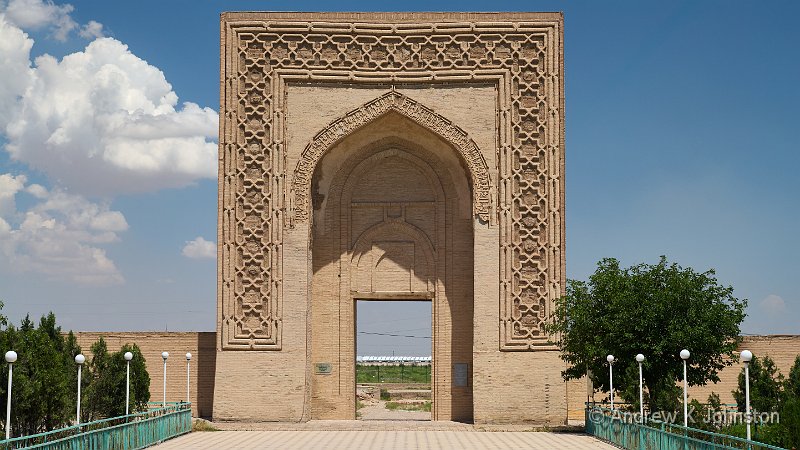
| Rabat Malik Caravanserai Portal (Show Details) |
On the way into Bukhara Ganisher talks about some of the famous citizens of the city. History teaching has moved on from the position when I was young that nothing much happened to human knowledge between the Romans leaving Britain and the Renaissance. We acknowledge the founding role of Islamic scholarship, but it’s often still vaguely credited to "Arabs" as if it must have happened somewhere around the Mediterranean. Nothing could be further from the truth.
Ibn Sina was a native of Bukhara. He was a pre-eminent physician, who in many ways founded modern medicine. The "cine" in "medicine" comes from his name.
Mathematician Muhammad ibn Musa al-Khwarizmi worked in Bagdhad, in Arabic, but was born in Khiva (our next stop). One of his most famous treatises was "Al-Jabr", from which we get the name for algebra, and his own name became the term we use for systematic solutions to mathematical problems, algorithms.
We get to Bukhara in time for lunch followed by exploration of the historical centre. We see some great market displays, and also get some architectural shots in the old madrassa and mosque. Later on we take an electric cart drive to the fort, and watch sundown over the city, although clouds mean the light isn’t ideal.
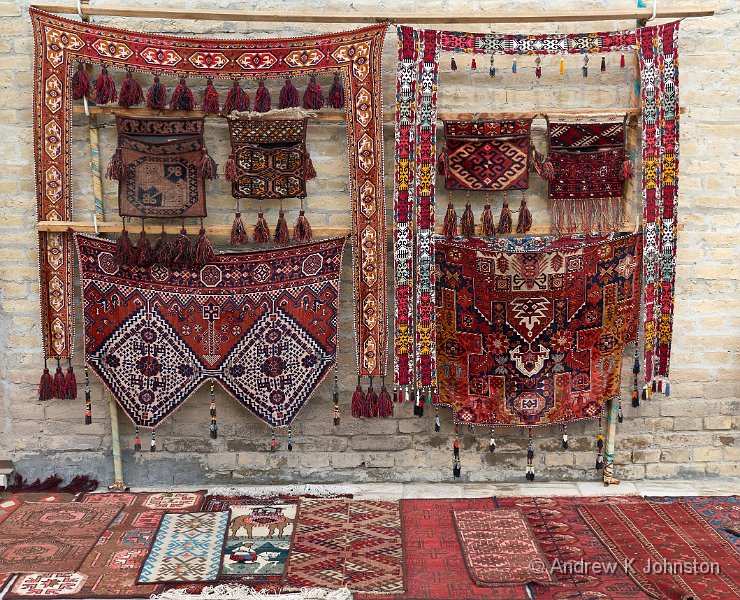
| Bukhara bazaar display (Show Details) |
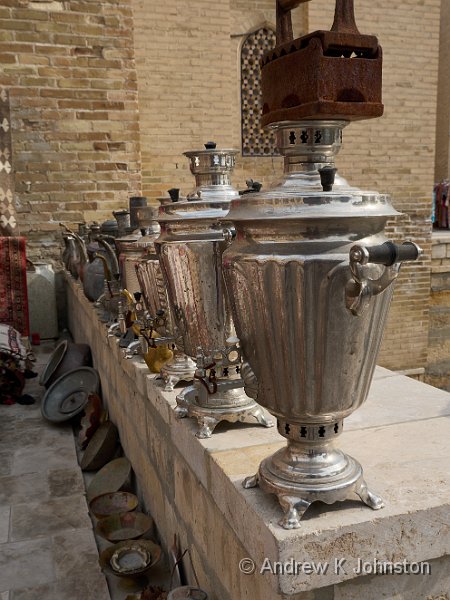
| Bukhara bazaar display (Show Details) |
We then descend and rejoin our cart, which takes an interminable back street route to a restaurant situated both walking distance from our hotel, and probably only 5 minutes from the fort. Pedestrianisation of the centre has both upside and downsides!
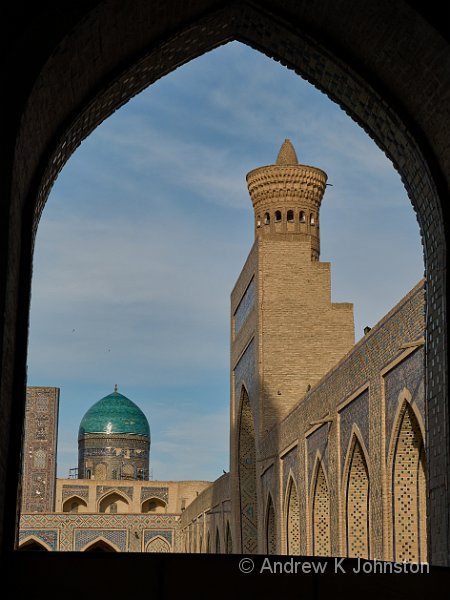
| Bukhara historic centre (Show Details) |
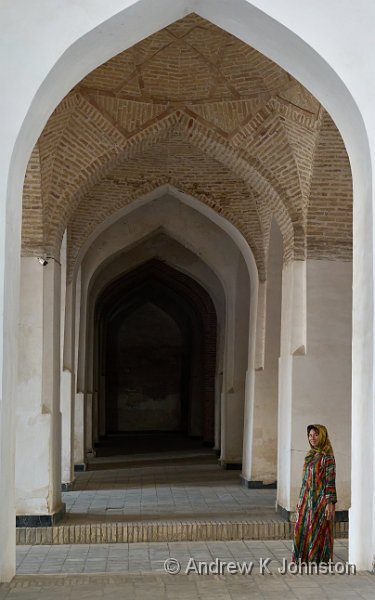
| Poy Kalan religious complex, Bukhara (Show Details) |


 Email me
 Others
 Main feed (direct XML)