Annoyance-Based Technology Selection
As a well-known gadget fan, it pains me to admit I'm becoming increasingly frustrated with some day to day technology. I've recently had a run of bad luck with equipment having to be replaced or repaired due to unpredicted failure, but most of all it seems to be impossible to get a mobile phone which simply and reliably meets my requirements.
I don't think my requirements should be that challenging. I want a phone which is a good device for making phone calls on: easy to use, clear and able to work in most frequency bands and signal conditions. It should be light to carry. When in my car it should be safe to use and clearly audible (both ways), top up or top down, but I'm very happy to use a proper wired headset to achieve this.
I would like it to synchronise with my Outlook contacts, but I really don't want or need a camera, or a PDA, or a coffee maker or food processor built in. Digital convergence is still a myth. A combined phone/PDA/camera/GPS is likely to be a poor phone, a poor PDA, a poor camera and a poor navigation system, and my own personal enterprise architecture is still happily based around quality "best of breed" solutions.
This does lead to a certain proliferation of equipment. The following
frightening and only slightly posed photo shows the situation chez Andrew on a
particularly bad day...
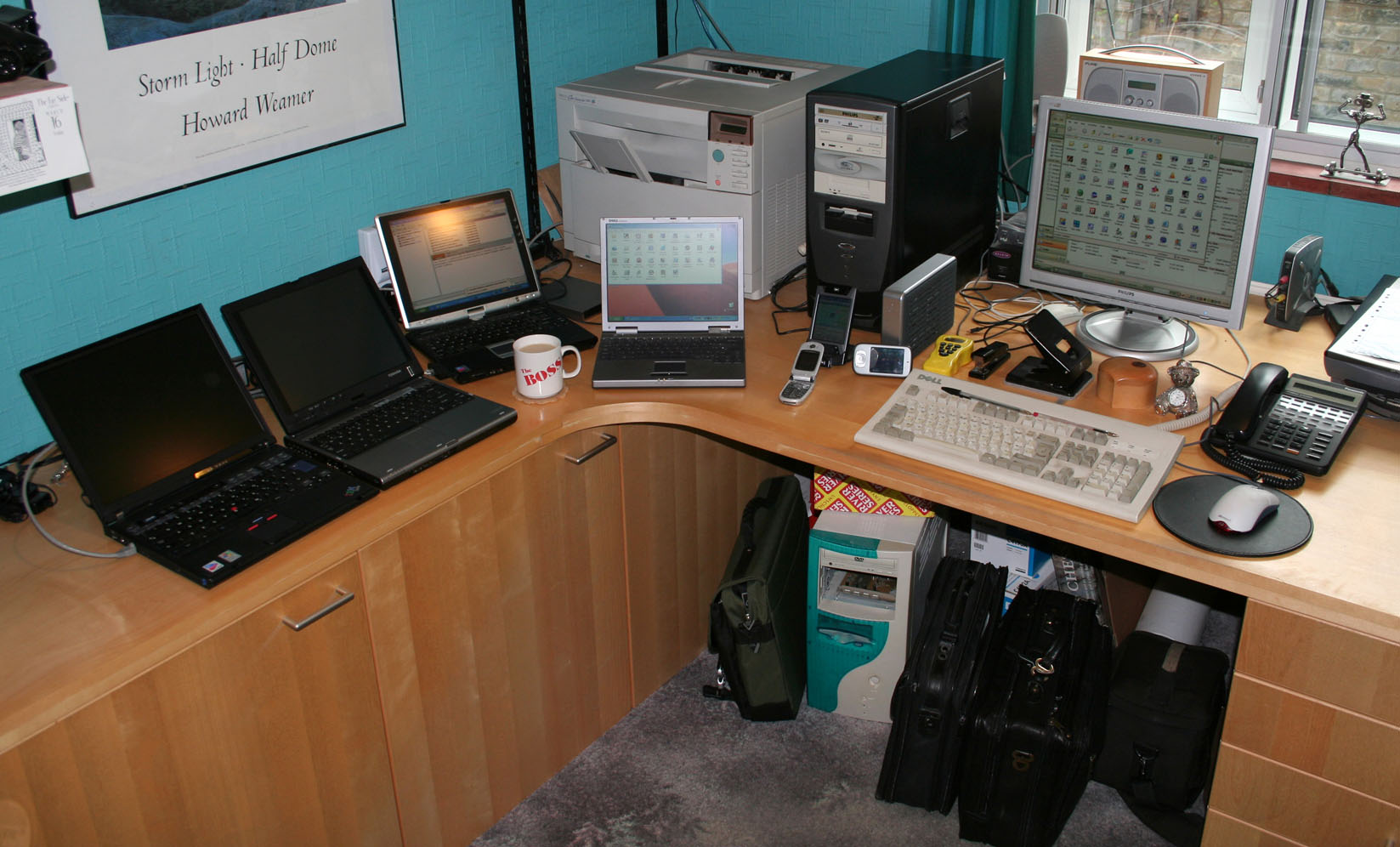
The trouble is, I don't think the phone I'm looking for exists. My first phone, a Motorola V3690, served me well for several years and still works for my wife. Eventually I grew tired of its limitations, but since I retired it I've had a string of phones, none of which have been "quite right".
Feature comparison lists provided by suppliers don't help. Neither do most reviews. The problem is that these assessments tend to focus on the positive, with a "yes it does have that feature" approach. This helps eliminate options which just can't meet a "must have" requirement, but they're misleading.
For example, a feature list for my phones since the V3690 might look like the following. To keep it simple I've ignored things which they all did adequately, like tri-band working, and things which are completely irrelevant (to me), like a built-in camera:
| Sony T610i | Motorola V600 | T-Mobile MDA Compact II | Motorola MPX200 | |
| Bluetooth support | Y | Y | Y | N |
| Syncs with PC | Y | Y | Y | Y |
| Supports wired headsets | Y | Y | Y | Y |
| Flip design (my preference) | N | Y | N | Y |
| Score | 3 | 4 | 3 | 3 |
Well, it's looking good for the V600, but this doesn't tell us much. I could easily extend the list with some positive observations of my own:
| Sony T610i | Motorola V600 | T-Mobile MDA Compact II | Motorola MPX200 | |
| Bluetooth support | Y | Y | Y | N |
| Syncs with PC | Y | Y | Y | Y |
| Supports wired headsets | Y | Y | Y | Y |
| Flip design (my preference) | N | Y | N | Y |
| Fits well in my car | N | N | Y | N |
| Provides good platform for in-car navigation | N | N | Y | N |
| Gets a good signal under adverse conditions | N | Y | Y | N |
| Natural-language voice dialling (e.g. MS Voice Command) | N | N | Y | N |
| Score | 3 | 5 | 7 | 3 |
So a "positive" review puts the MDA in pole position....
However, when you live with something day in, day out, what it does well no longer matters - you just take these things for granted. What is does badly, the little annoyances, are what really matter. Some you can live with, but if there are too many, or one which is just too annoying, you'll give up. If you're a technophile, you'll start the search for the "ideal" replacement. If you're a technophobe you may give up entirely.
Let's try and itemise the annoying little "features" of the four phones:
| Sony T610i | Motorola V600 | T-Mobile MDA Compact II | Motorola MPX200 | |
| Keyboard designed for 5 year old fingers | Y | N | N | N |
| Non-standard headset connector | Y | N | Y | N |
| Non-standard power / data connector (so I have to carry special cables or charger) | Y | Y | N | N |
| No ring tone when headset plugged in | Y | N | Y | N |
| Slow start-up (30 seconds or more) | Y | N | Y | N |
| Really slow start-up (2 minutes +) | N | N | Y | N |
| Annoying "branding" tunes at startup and, worse, shut-down | N | Y | N | N |
| Clumsy contact handling - have to scroll through contacts one number at a time | N | Y | N | N |
| No auto-repeat on keys | N | Y | N | N |
| Returns to home screen too quickly when composing numbers | N | Y | Y | N |
| Limited memory for voice tags | N | Y | N | N |
| Barely audible at maximum volume or on headset | N | N | Y | N |
| Unstable software - frequent freezes or random reboots | Y | N | Y | N |
| Protruding buttons get pressed accidentally in the pocket | Y | Y | Y | N |
| PC sync software costs extra | N | Y | N | N |
| PC sync software clumsy | N | Y | N | N |
| Bulk pushes jacket pocket out of shape | N | Y | Y | Y |
| Poor battery life (3 days or less) | N | N | Y | Y |
| Doesn't work (properly) with Bluetooth headsets | N | N | Y | Y |
| Score | -7 | -10 | -11 | -3 |
| Score (net of positives) | -4 | -5 | -4 | 0 |
So none is even in positive territory. It's actually worse than the simplistic scoring above suggests. I definitely weight an annoyance higher than something a phone does well. And then some annoyances compound one another. For example, a long startup time compounds the effect of random reboots (T610i and MDA). A poor user interface and limited voice tag memory compounds the contact handling problems of the V600. Take these together and the score looks more like this:
| Sony T610i | Motorola V600 | T-Mobile MDA Compact II | Motorola MPX200 | |
| Weighted Score | -16 | -21 | -21 | -3 |
All of which maybe explains why I'm currently using a three year old MPX200 bought on eBay for £40!
What we need from reviewers is more focus on the failings of technology. Some
specialist magazines and independent reviews do get this right. Camera
magazines, for example, usually consider "handling" and you often see comments
like "the depth of field preview button is inaccessible and could become
annoying in regular use". Unfortunately this good practice is the exception
rather than the norm.
I have learned the hard way that nothing is perfect. I now think progress is to
minimise the number of annoyances you have to live with. In terms of my phone,
maybe if I can get an MX220 (which is basically an MPX200 with Bluetooth
and better battery life), and if it doesn't add too many annoyances of
its own, then I might finally end up in a positive position.
Wish me luck!
Addendum
Before I finished this article, I managed to obtain an MPX220. It's a lightweight flip phone running Windows Mobile 2003, with decent battery life and built-in voice recognition. It's off to a good start, and gets rid of some of the 200's failings. I give it a positive score of 6, using the same list as above.
However, it's not perfect. The power/data connector is the same non-standard (and rather flimsy) one as the V600. What's wrong with mini USB? It does have music at start-up and shut-down, but this is fairly subtle and may be configurable. The main problem is that there's no ring tone when the headset is plugged in. What's really annoying is that Motorola managed to get this right in the V600, which appears to share some key components!
So it gets a "negative" score of -2.5 (allowing for some uncertainty on the power-down tones issue). And at long last the weighted score rises above 0, to a grand total of 1. Ta-da!
Is this technological progress?
Comments
If you'd like to comment on this article, with ideas, examples, or just to praise it to the skies then I'd love to hear from you.


 Email me
 @TweetAndrewJ
 Others
 Thoughts on the World (Main Feed)
 Main feed (direct XML)